DAMIEN HIRST "CORNED BEEF: LAST SUPPER" SCREENPRINT, 1999
Damien Hirst is arguably Britains most successful living artist. Since the late 1980s, he has created installations, sculptures, paintings, prints, and drawings that examine the complex relationships between art and beauty, religion and science, and life and death. He established his reputation, as both an artist and curator, in the 1990's with a new generation of creators knowns as the Young British Artists (YBAs).
Hirst has become one of the art worlds' most recognized, discussed, and collected provocateurs. His earlier work, like his iconic sharks suspended in formaldehyde tanks incite strong, visceral responses that divide audiences on both sides of the pond.
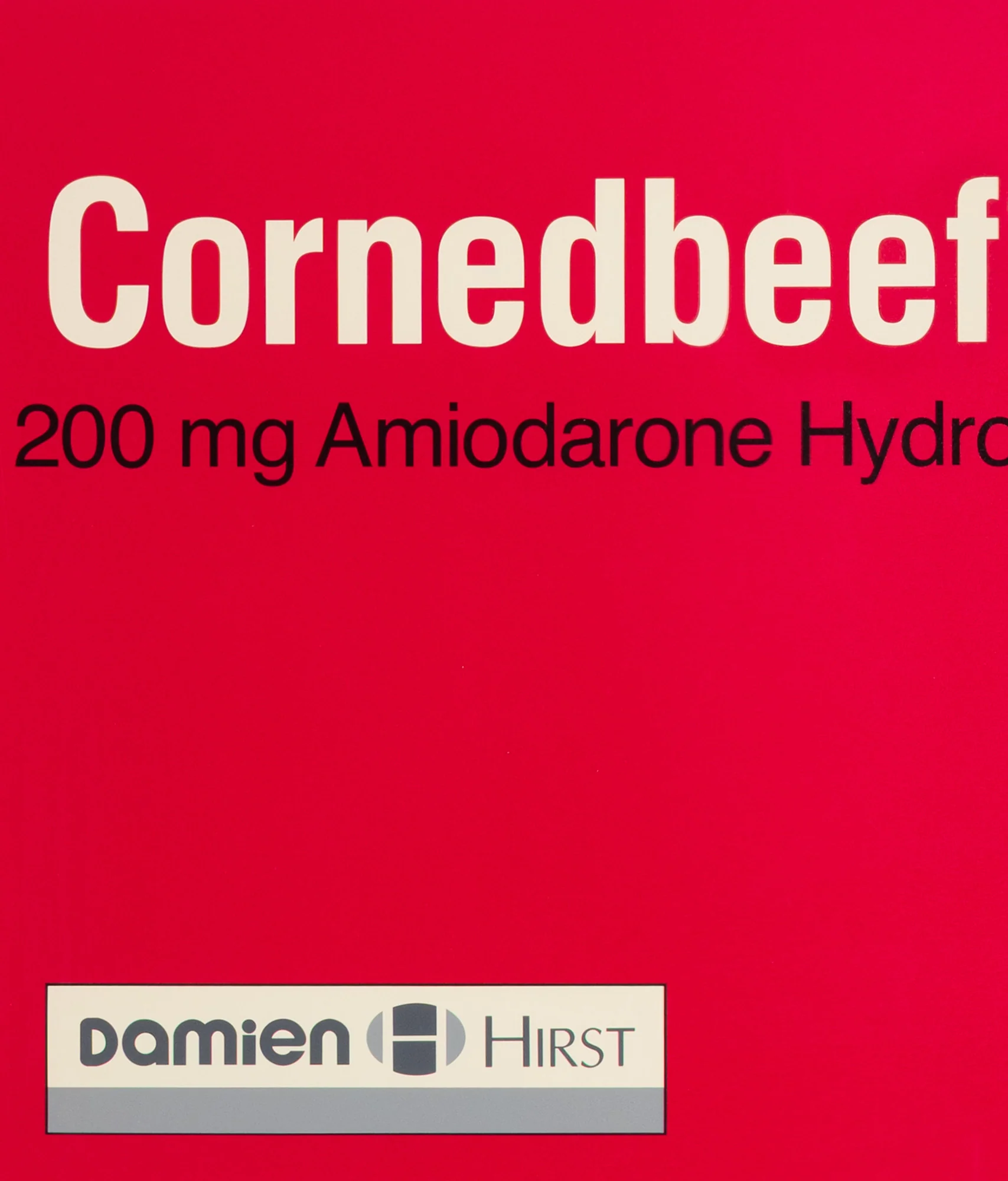
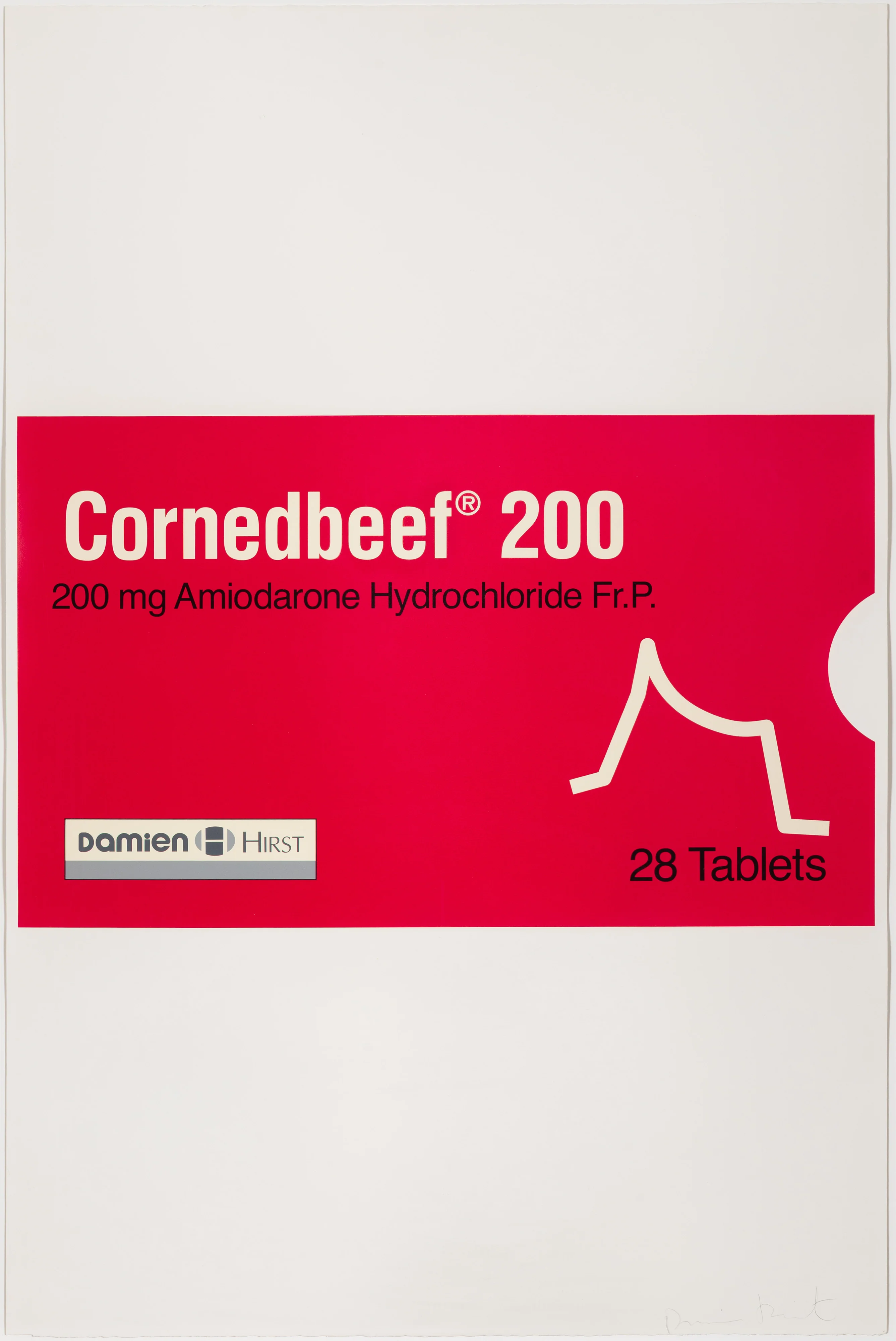
"Corned Beef" is one of thirteen screenprints from Hirst’s The Last Supper series. Within the grouping, Hirst mimics pharmaceutical packaging but replaces the name of a medication with that of common British foods. The series is one of several commissioned from British artists by Charles Booth-Clibborn, and published by his imprint, The Paragon Press, London.
These oversized prints questions our credulous nature towards pharmaceuticals, suggesting that our trust and dependency toward modern medicine is akin to blind faith in religion. The number of prints in the suite echoes the number of disciples present at The Last Supper – demonstrating Hirst's attention to detail and intentionality throughout his oevre.
By drawing connections between religion and medicine, Hirst suggests that we now place our trust in the latter and consume medication as unquestioningly as food. Drawing a further comparison between the mass commercialization of pharmaceuticals and fast food, Hirst highlights the omnipresence of both industries, as well as their physiological consequences, which often go unrecognized.
Hirst first began including medical imagery and motifs in his work as early as the 1980s. This work is exemplary of Hirst’s critical analysis of big pharma and his commitment to subverting and questioning its widespread acceptance...with his unmistakable cheeky British humor.
"Corned Beef" is held in the permanent collections of the MoMA, New York; the Broad, LA; the National Galleries, UK; the Tate, London; the National Gallery, Washington, DC; and the National Gallery of Victoria, Australia.
Questions about this piece? Contact us, call +1.416.704.1720, or visit our Toronto gallery.
"Corned Beef" from The Last Supper
England, 1999
Color screenprint on Somerset wove paper
Signed in pencil, lower right
From an edition of 150
Printed at Coriander Studio, London
Published by Paragon Press, London
60.5”H 40”W (work)
64.25"H 44"W (framed)
Framed with plexiglass
Very good condition
More Images



DAMIEN HIRST "CORNED BEEF: LAST SUPPER" SCREENPRINT, 1999
Damien Hirst is arguably Britains most successful living artist. Since the late 1980s, he has created installations, sculptures, paintings, prints, and drawings that examine the complex relationships between art and beauty, religion and science, and life and death. He established his reputation, as both an artist and curator, in the 1990's with a new generation of creators knowns as the Young British Artists (YBAs).
Hirst has become one of the art worlds' most recognized, discussed, and collected provocateurs. His earlier work, like his iconic sharks suspended in formaldehyde tanks incite strong, visceral responses that divide audiences on both sides of the pond.
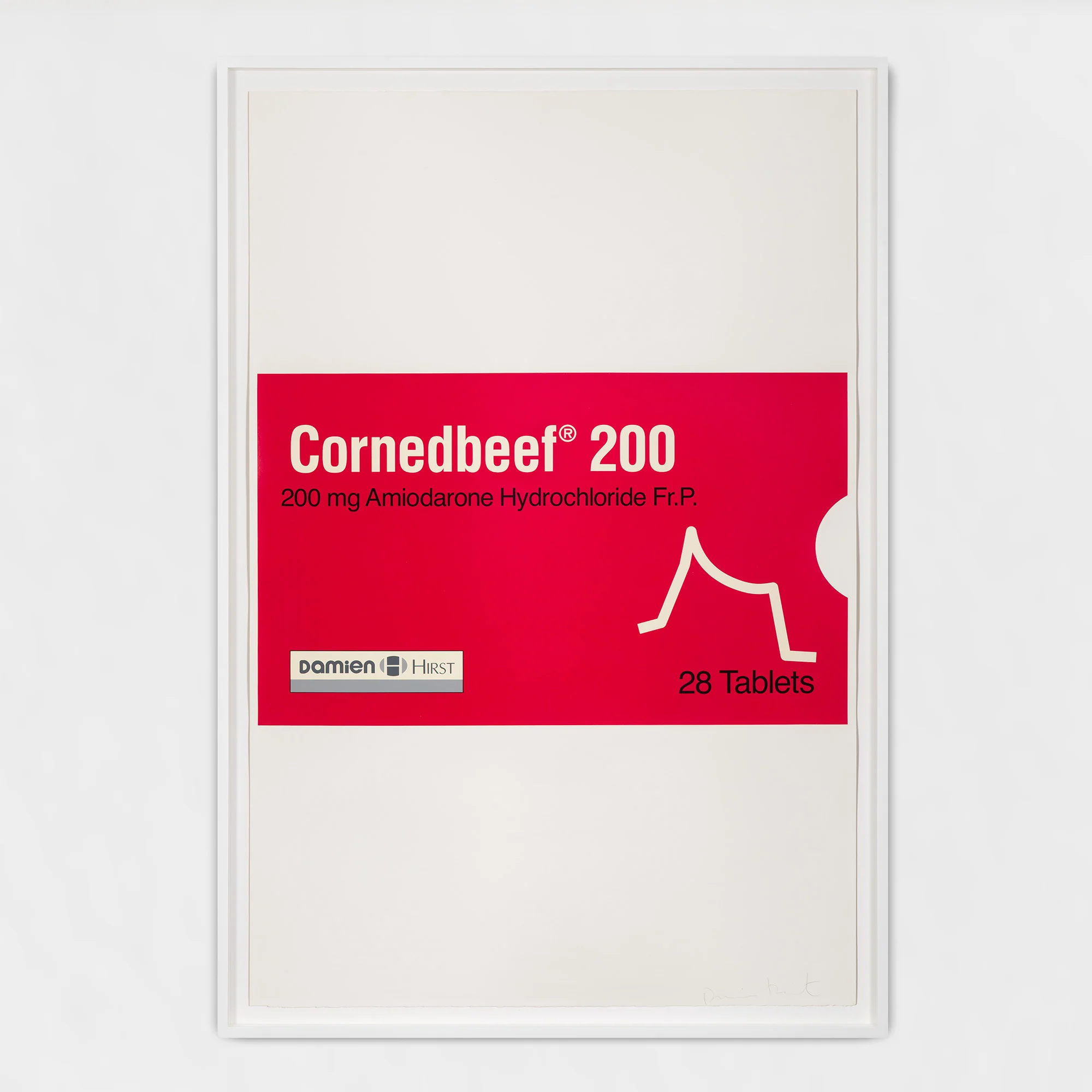
"Corned Beef" is one of thirteen screenprints from Hirst’s The Last Supper series. Within the grouping, Hirst mimics pharmaceutical packaging but replaces the name of a medication with that of common British foods. The series is one of several commissioned from British artists by Charles Booth-Clibborn, and published by his imprint, The Paragon Press, London.
These oversized prints questions our credulous nature towards pharmaceuticals, suggesting that our trust and dependency toward modern medicine is akin to blind faith in religion. The number of prints in the suite echoes the number of disciples present at The Last Supper – demonstrating Hirst's attention to detail and intentionality throughout his oevre.
By drawing connections between religion and medicine, Hirst suggests that we now place our trust in the latter and consume medication as unquestioningly as food. Drawing a further comparison between the mass commercialization of pharmaceuticals and fast food, Hirst highlights the omnipresence of both industries, as well as their physiological consequences, which often go unrecognized.
Hirst first began including medical imagery and motifs in his work as early as the 1980s. This work is exemplary of Hirst’s critical analysis of big pharma and his commitment to subverting and questioning its widespread acceptance...with his unmistakable cheeky British humor.
"Corned Beef" is held in the permanent collections of the MoMA, New York; the Broad, LA; the National Galleries, UK; the Tate, London; the National Gallery, Washington, DC; and the National Gallery of Victoria, Australia.
Questions about this piece? Contact us, call +1.416.704.1720, or visit our Toronto gallery.
"Corned Beef" from The Last Supper
England, 1999
Color screenprint on Somerset wove paper
Signed in pencil, lower right
From an edition of 150
Printed at Coriander Studio, London
Published by Paragon Press, London
60.5”H 40”W (work)
64.25"H 44"W (framed)
Framed with plexiglass
Very good condition
Product Information
Product Information
Shipping & Returns
Shipping & Returns
Description
Damien Hirst is arguably Britains most successful living artist. Since the late 1980s, he has created installations, sculptures, paintings, prints, and drawings that examine the complex relationships between art and beauty, religion and science, and life and death. He established his reputation, as both an artist and curator, in the 1990's with a new generation of creators knowns as the Young British Artists (YBAs).
Hirst has become one of the art worlds' most recognized, discussed, and collected provocateurs. His earlier work, like his iconic sharks suspended in formaldehyde tanks incite strong, visceral responses that divide audiences on both sides of the pond.
"Corned Beef" is one of thirteen screenprints from Hirst’s The Last Supper series. Within the grouping, Hirst mimics pharmaceutical packaging but replaces the name of a medication with that of common British foods. The series is one of several commissioned from British artists by Charles Booth-Clibborn, and published by his imprint, The Paragon Press, London.
These oversized prints questions our credulous nature towards pharmaceuticals, suggesting that our trust and dependency toward modern medicine is akin to blind faith in religion. The number of prints in the suite echoes the number of disciples present at The Last Supper – demonstrating Hirst's attention to detail and intentionality throughout his oevre.
By drawing connections between religion and medicine, Hirst suggests that we now place our trust in the latter and consume medication as unquestioningly as food. Drawing a further comparison between the mass commercialization of pharmaceuticals and fast food, Hirst highlights the omnipresence of both industries, as well as their physiological consequences, which often go unrecognized.
Hirst first began including medical imagery and motifs in his work as early as the 1980s. This work is exemplary of Hirst’s critical analysis of big pharma and his commitment to subverting and questioning its widespread acceptance...with his unmistakable cheeky British humor.
"Corned Beef" is held in the permanent collections of the MoMA, New York; the Broad, LA; the National Galleries, UK; the Tate, London; the National Gallery, Washington, DC; and the National Gallery of Victoria, Australia.
Questions about this piece? Contact us, call +1.416.704.1720, or visit our Toronto gallery.
"Corned Beef" from The Last Supper
England, 1999
Color screenprint on Somerset wove paper
Signed in pencil, lower right
From an edition of 150
Printed at Coriander Studio, London
Published by Paragon Press, London
60.5”H 40”W (work)
64.25"H 44"W (framed)
Framed with plexiglass
Very good condition