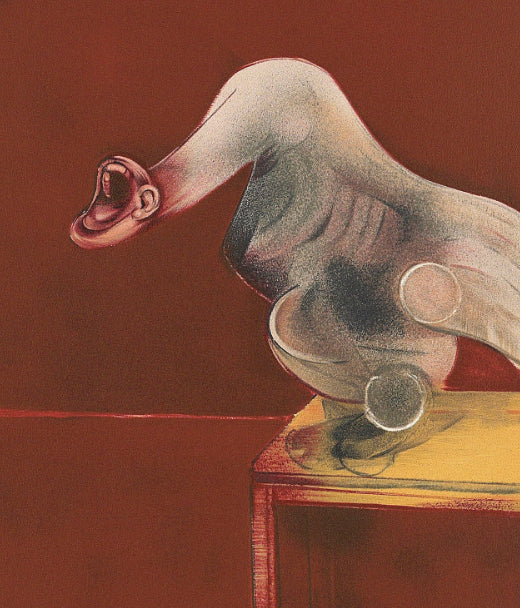
FRANCIS BACON "SECOND VERSION, TRIPTYCH 1944" LITHOGRAPH, 1989
Francis Bacon (1909-1992) is one of the most distinctive, provocative, and influential painters of the 20th century. He is a true disrupter in the canon of Art History.
His singular aesthetic was an intersection between abstraction and expressionistic portraiture. While the subjects in his paintings were often identified, distinctive features were typically smeared and distorted, often reflecting their inner turmoil or the artist's conflicting emotions related to his subject.
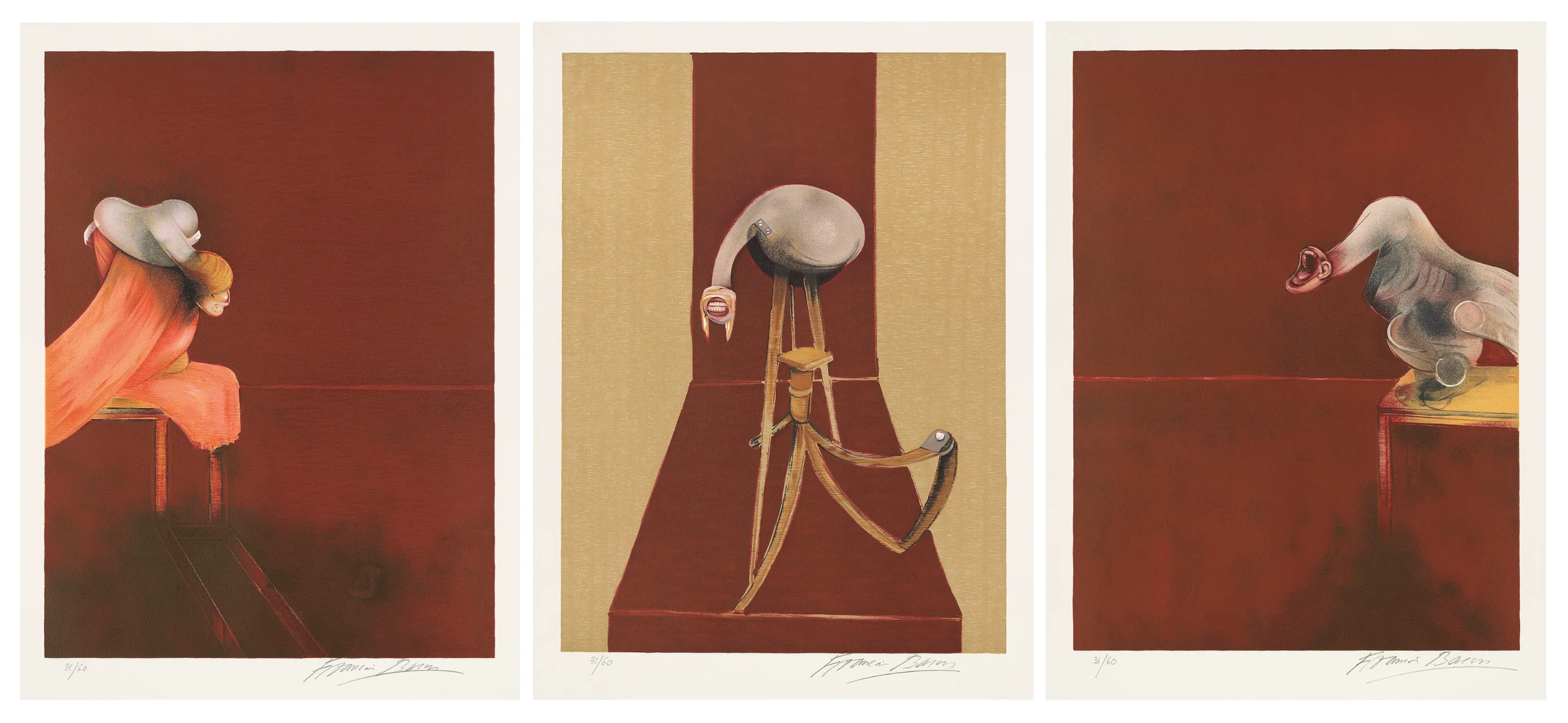
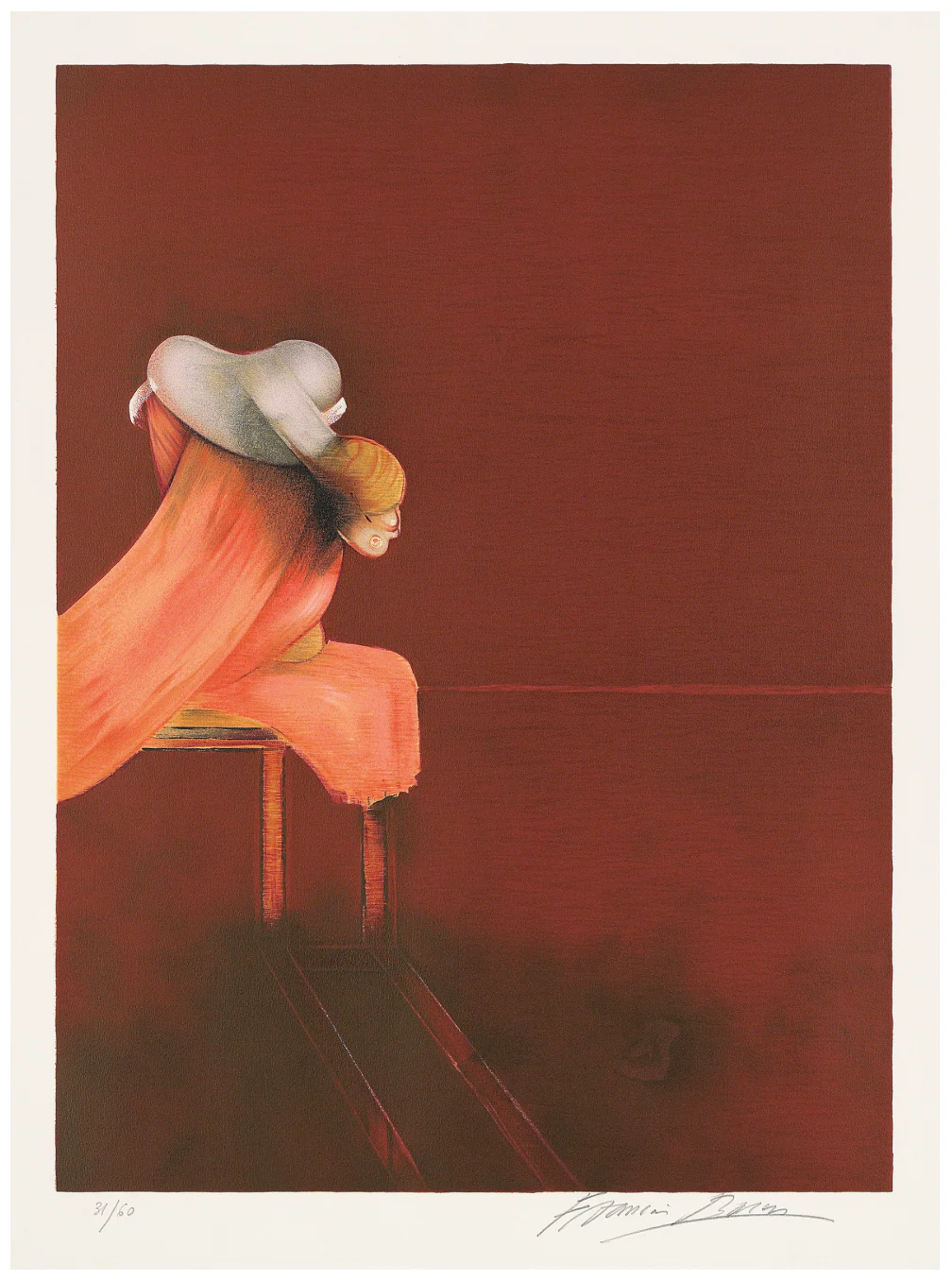
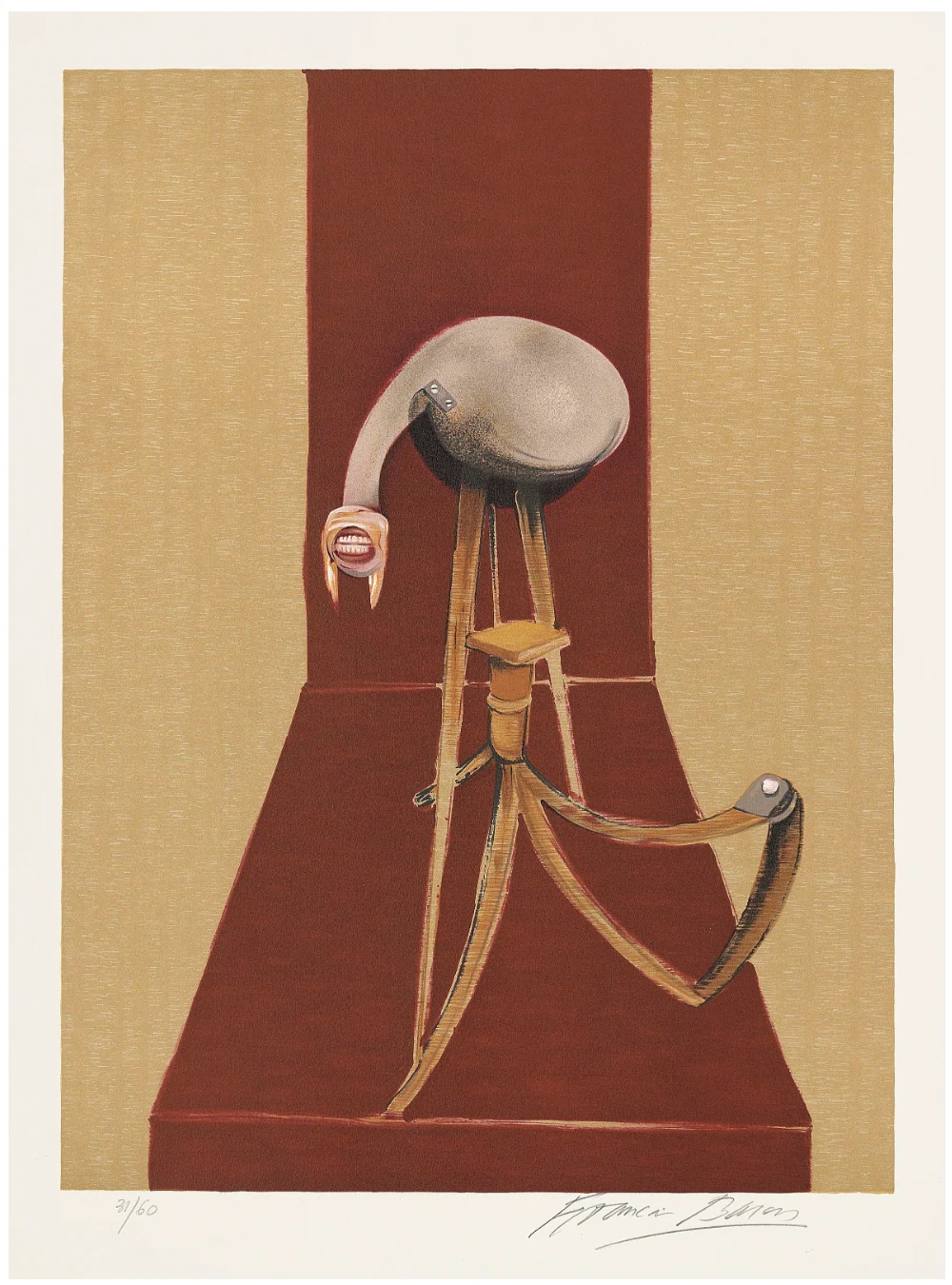
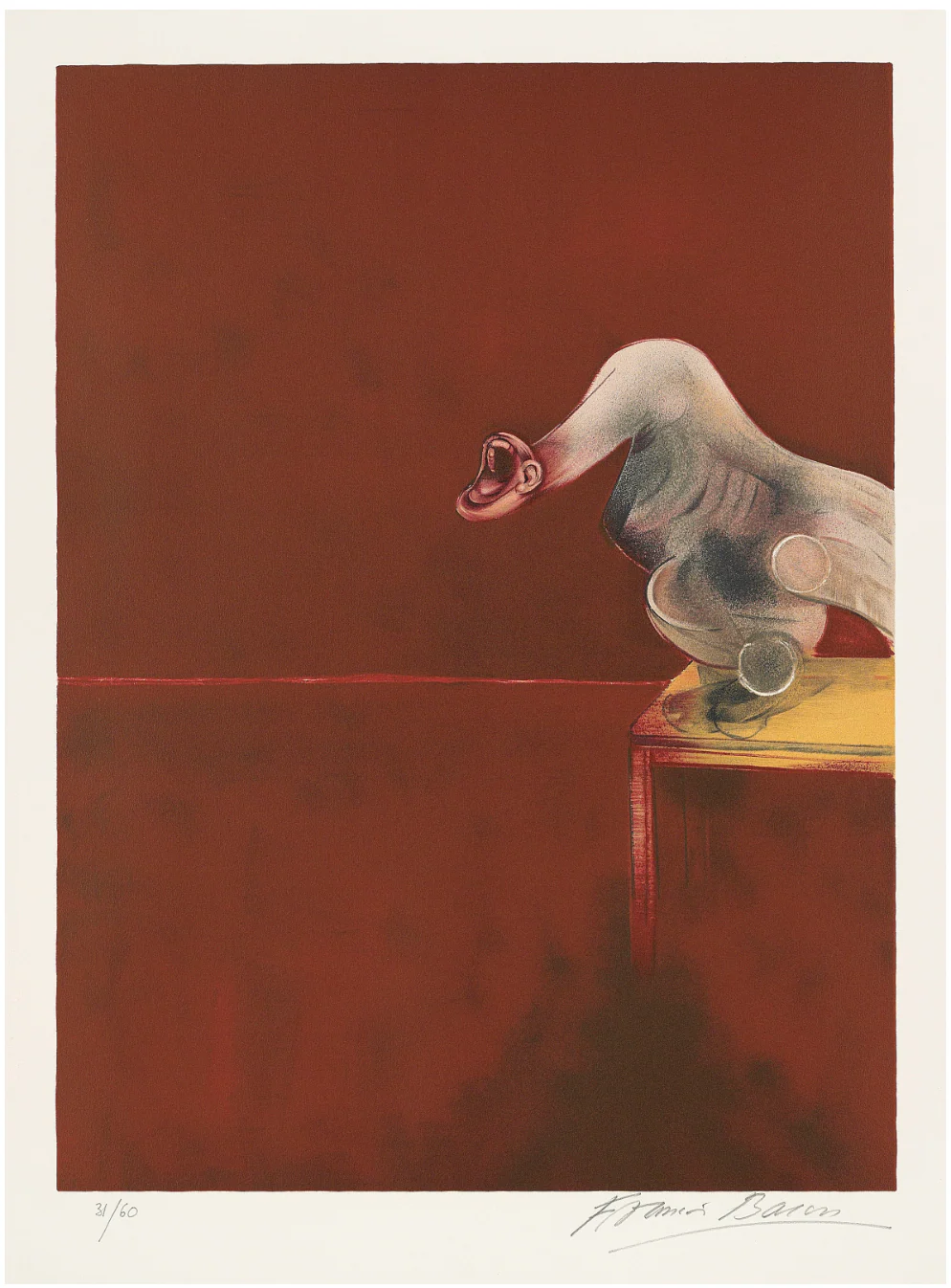
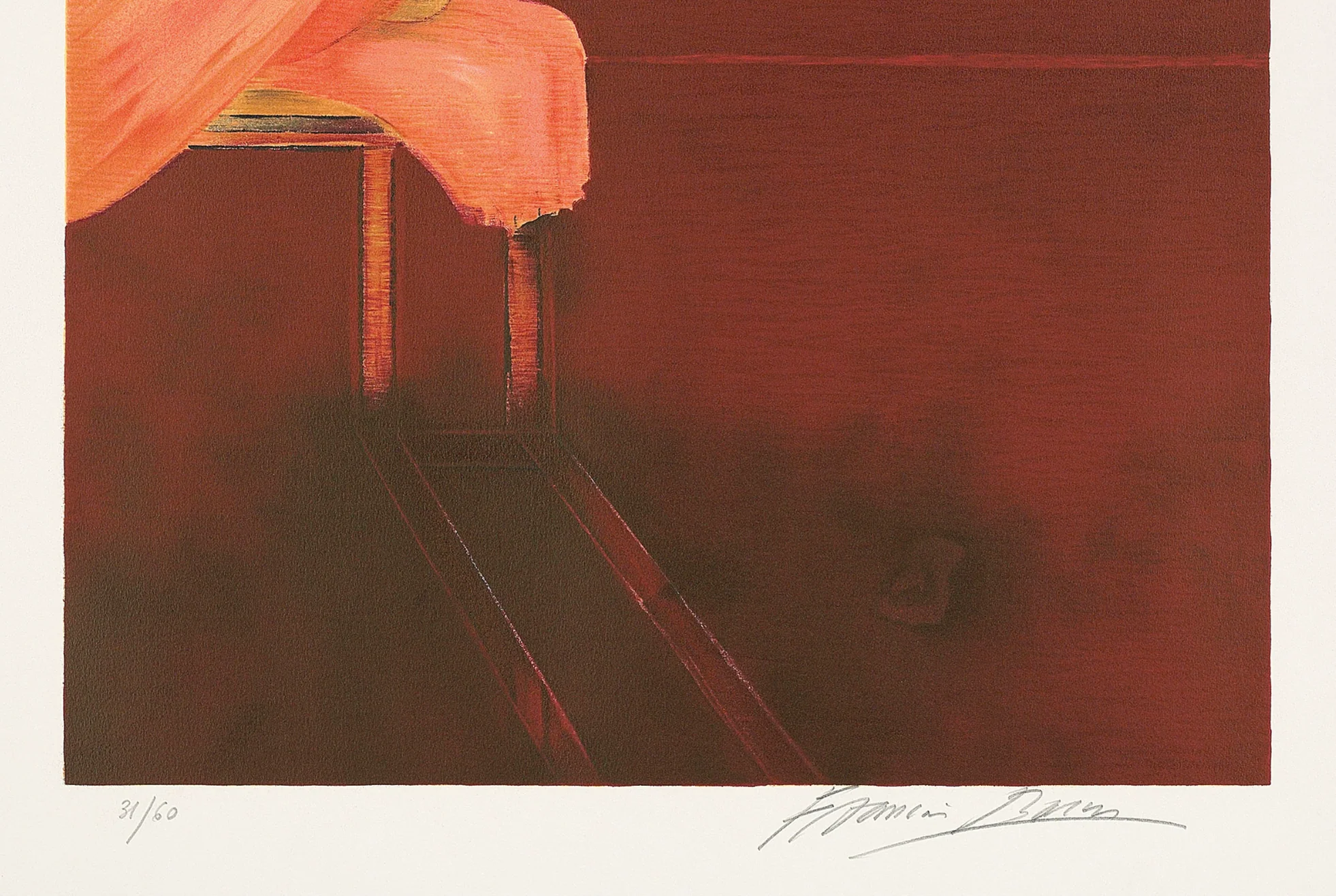
"Second Version of Triptych, 1944" is a 1988 reworking of Three Studies for Figures at the Base of a Crucifixion. Created at the age of 78, it was the artist's last triptych. While the focal figures in the Second Version are comparable to the first, they are smaller on the larger canvases, plunged into a deep void. Bacon also changed the orange background to a deep crimson/rust red, heightening the sense of inherent violence.
The distorted anthropomorphic creatures howl and scream, echoing the version he created during the Second World War. These figures recall the vengeful Greek Furies and Christian crucifixion imagery. Punishing those who go against the natural order, the Greek Furies are a pointed representation from Bacon, reflecting the horrors of war, the Holocaust, and a world order in flux.
Visceral and haunting, each "figure" maintains their independence and awful intensity. Harrowing postures, gnawing teeth, contorted limbs, and bulbous masses evoke a characteristic nightmarish essence that remains ever present in Bacon's oeuvre.
This set of three lithographs was produced one year after the painting, at a time when Bacon's work was being shown globally. As an intentional reworking of one of his most important paintings, this artwork would be a notable addition to any collection.
Over the years, this triptych of lithographs have regularly been split up, with each element being sold independently. It is increasingly rare to find a complete triptych like this one on the secondary market.
Today, Bacon's canvases fetch astounding prices at auction, achieving a record of $142.4 million in 2014.
Questions about this piece? Contact us, call +1.416.704.1720, or visit our Toronto Gallery.
"Second Version, Triptych 1944"
Paris, 1989
The complete set of three lithographs in colors on Arches wove paper
Signed and numbered "31/60" in pencil, lower edge
From an edition of 60
Published by Michael Archimbaud for Librairie Séguier for IRCAM, Centre Pompidou, Paris, the full sheets
Printed by Art Estampe
29.75"H 22"W (each sheet)
36.25"H 29.25"W (each frame)
Very good condition
Literature: Bruno Sabatier, Francis Bacon: The Graphic Work, no. 24.
Reference: Sabatier 24
Note: Framed images coming soon.
More Images
FRANCIS BACON "SECOND VERSION, TRIPTYCH 1944" LITHOGRAPH, 1989
Francis Bacon (1909-1992) is one of the most distinctive, provocative, and influential painters of the 20th century. He is a true disrupter in the canon of Art History.
His singular aesthetic was an intersection between abstraction and expressionistic portraiture. While the subjects in his paintings were often identified, distinctive features were typically smeared and distorted, often reflecting their inner turmoil or the artist's conflicting emotions related to his subject.
"Second Version of Triptych, 1944" is a 1988 reworking of Three Studies for Figures at the Base of a Crucifixion. Created at the age of 78, it was the artist's last triptych. While the focal figures in the Second Version are comparable to the first, they are smaller on the larger canvases, plunged into a deep void. Bacon also changed the orange background to a deep crimson/rust red, heightening the sense of inherent violence.
The distorted anthropomorphic creatures howl and scream, echoing the version he created during the Second World War. These figures recall the vengeful Greek Furies and Christian crucifixion imagery. Punishing those who go against the natural order, the Greek Furies are a pointed representation from Bacon, reflecting the horrors of war, the Holocaust, and a world order in flux.
Visceral and haunting, each "figure" maintains their independence and awful intensity. Harrowing postures, gnawing teeth, contorted limbs, and bulbous masses evoke a characteristic nightmarish essence that remains ever present in Bacon's oeuvre.
This set of three lithographs was produced one year after the painting, at a time when Bacon's work was being shown globally. As an intentional reworking of one of his most important paintings, this artwork would be a notable addition to any collection.
Over the years, this triptych of lithographs have regularly been split up, with each element being sold independently. It is increasingly rare to find a complete triptych like this one on the secondary market.
Today, Bacon's canvases fetch astounding prices at auction, achieving a record of $142.4 million in 2014.
Questions about this piece? Contact us, call +1.416.704.1720, or visit our Toronto Gallery.
"Second Version, Triptych 1944"
Paris, 1989
The complete set of three lithographs in colors on Arches wove paper
Signed and numbered "31/60" in pencil, lower edge
From an edition of 60
Published by Michael Archimbaud for Librairie Séguier for IRCAM, Centre Pompidou, Paris, the full sheets
Printed by Art Estampe
29.75"H 22"W (each sheet)
36.25"H 29.25"W (each frame)
Very good condition
Literature: Bruno Sabatier, Francis Bacon: The Graphic Work, no. 24.
Reference: Sabatier 24
Note: Framed images coming soon.
Product Information
Product Information
Shipping & Returns
Shipping & Returns
Description
Francis Bacon (1909-1992) is one of the most distinctive, provocative, and influential painters of the 20th century. He is a true disrupter in the canon of Art History.
His singular aesthetic was an intersection between abstraction and expressionistic portraiture. While the subjects in his paintings were often identified, distinctive features were typically smeared and distorted, often reflecting their inner turmoil or the artist's conflicting emotions related to his subject.
"Second Version of Triptych, 1944" is a 1988 reworking of Three Studies for Figures at the Base of a Crucifixion. Created at the age of 78, it was the artist's last triptych. While the focal figures in the Second Version are comparable to the first, they are smaller on the larger canvases, plunged into a deep void. Bacon also changed the orange background to a deep crimson/rust red, heightening the sense of inherent violence.
The distorted anthropomorphic creatures howl and scream, echoing the version he created during the Second World War. These figures recall the vengeful Greek Furies and Christian crucifixion imagery. Punishing those who go against the natural order, the Greek Furies are a pointed representation from Bacon, reflecting the horrors of war, the Holocaust, and a world order in flux.
Visceral and haunting, each "figure" maintains their independence and awful intensity. Harrowing postures, gnawing teeth, contorted limbs, and bulbous masses evoke a characteristic nightmarish essence that remains ever present in Bacon's oeuvre.
This set of three lithographs was produced one year after the painting, at a time when Bacon's work was being shown globally. As an intentional reworking of one of his most important paintings, this artwork would be a notable addition to any collection.
Over the years, this triptych of lithographs have regularly been split up, with each element being sold independently. It is increasingly rare to find a complete triptych like this one on the secondary market.
Today, Bacon's canvases fetch astounding prices at auction, achieving a record of $142.4 million in 2014.
Questions about this piece? Contact us, call +1.416.704.1720, or visit our Toronto Gallery.
"Second Version, Triptych 1944"
Paris, 1989
The complete set of three lithographs in colors on Arches wove paper
Signed and numbered "31/60" in pencil, lower edge
From an edition of 60
Published by Michael Archimbaud for Librairie Séguier for IRCAM, Centre Pompidou, Paris, the full sheets
Printed by Art Estampe
29.75"H 22"W (each sheet)
36.25"H 29.25"W (each frame)
Very good condition
Literature: Bruno Sabatier, Francis Bacon: The Graphic Work, no. 24.
Reference: Sabatier 24
Note: Framed images coming soon.