PABLO PICASSO "CAVALIER ET CHEVAL" 1952
Pablo Picasso's (1881-1973) love affair with ceramics started in 1946, when he came across a pottery fair in the South of France. There, he met the proprietors of the Madoura Pottery workshop and started a collaborative relationship with the studio that lasted until his death.
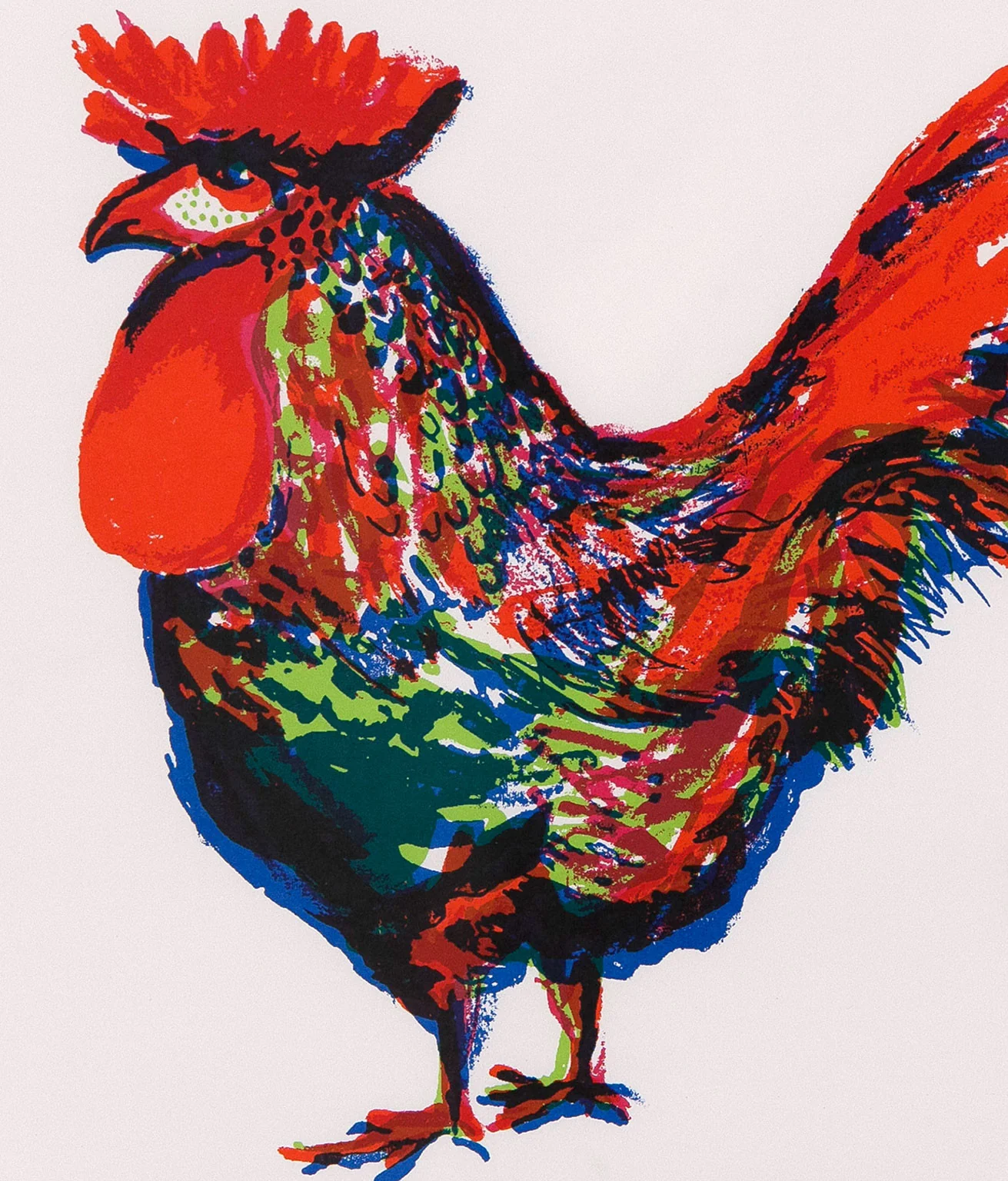
Inspired by Spanish folk ceramics, Picasso embraced traditional motifs such as bullfights, roosters, suns, and faces. He appreciated the medium for combining both painting and sculpture, using the three-dimensional surfaces as a canvas for exploring his favorite motifs.
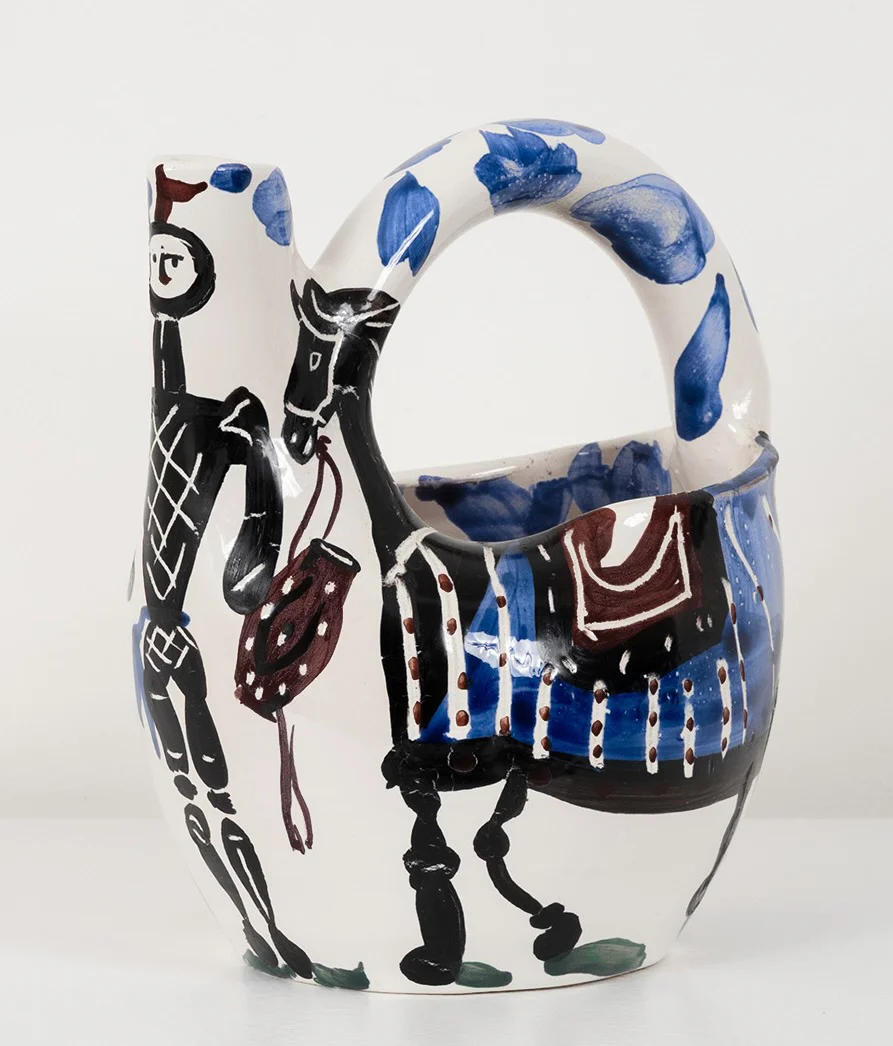
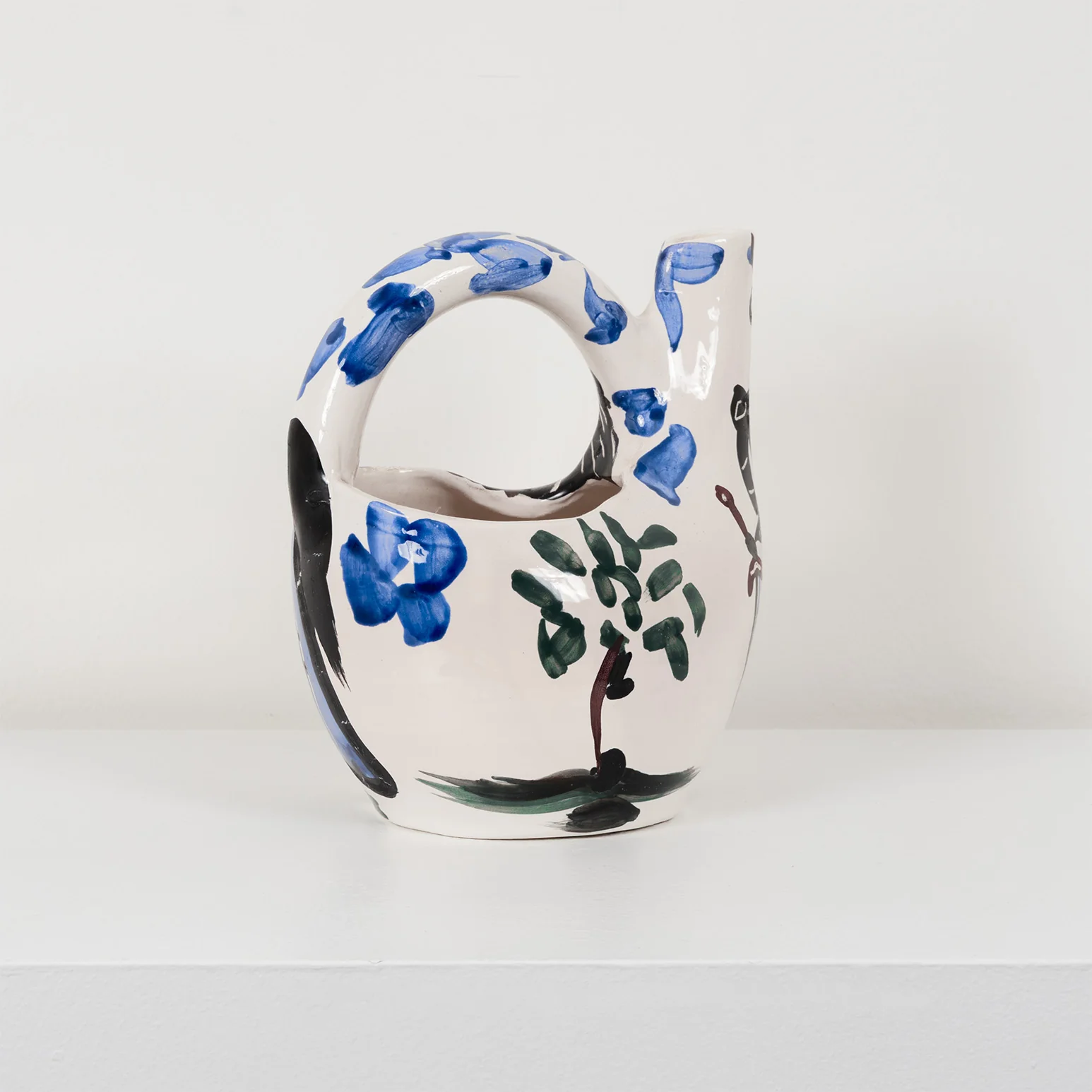
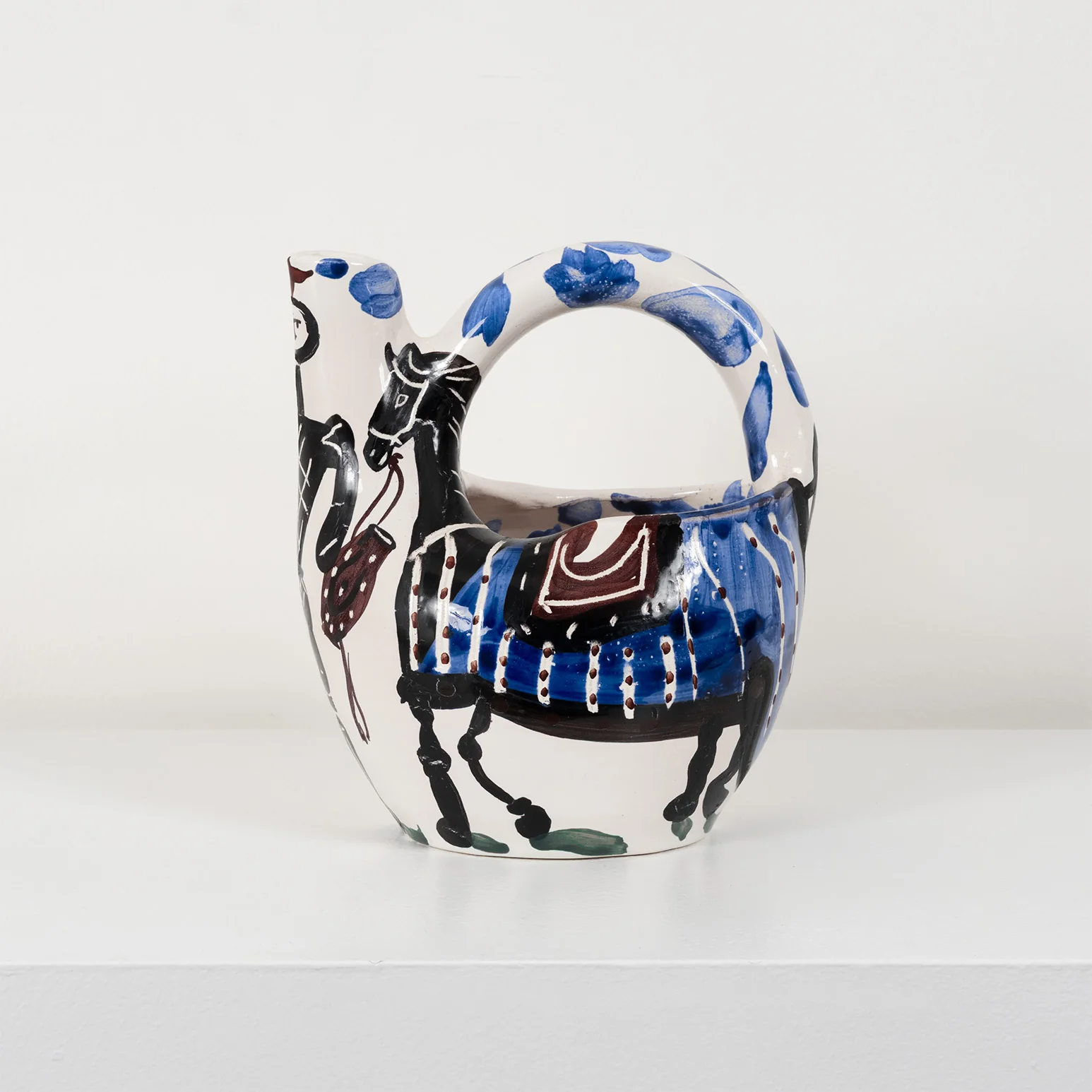
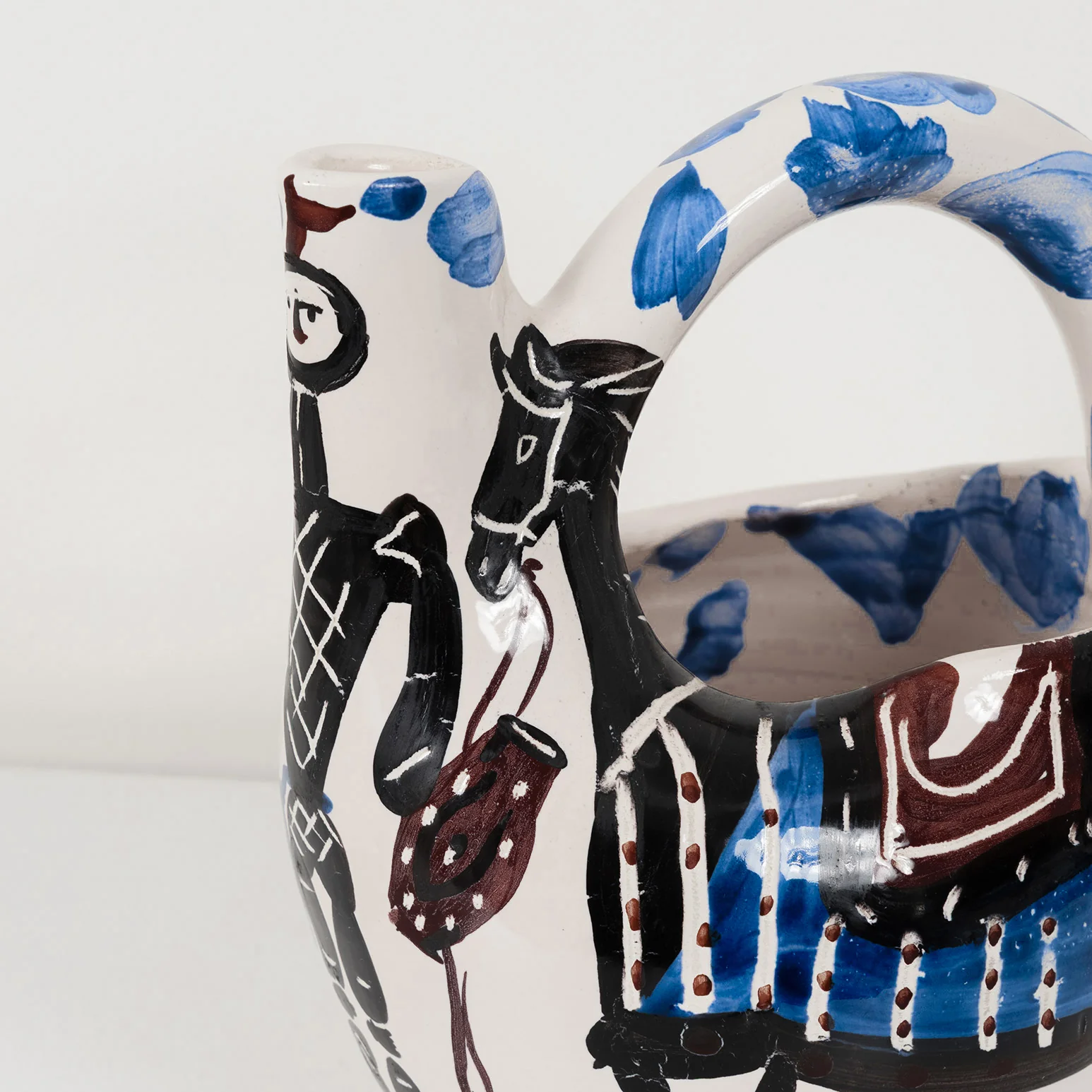
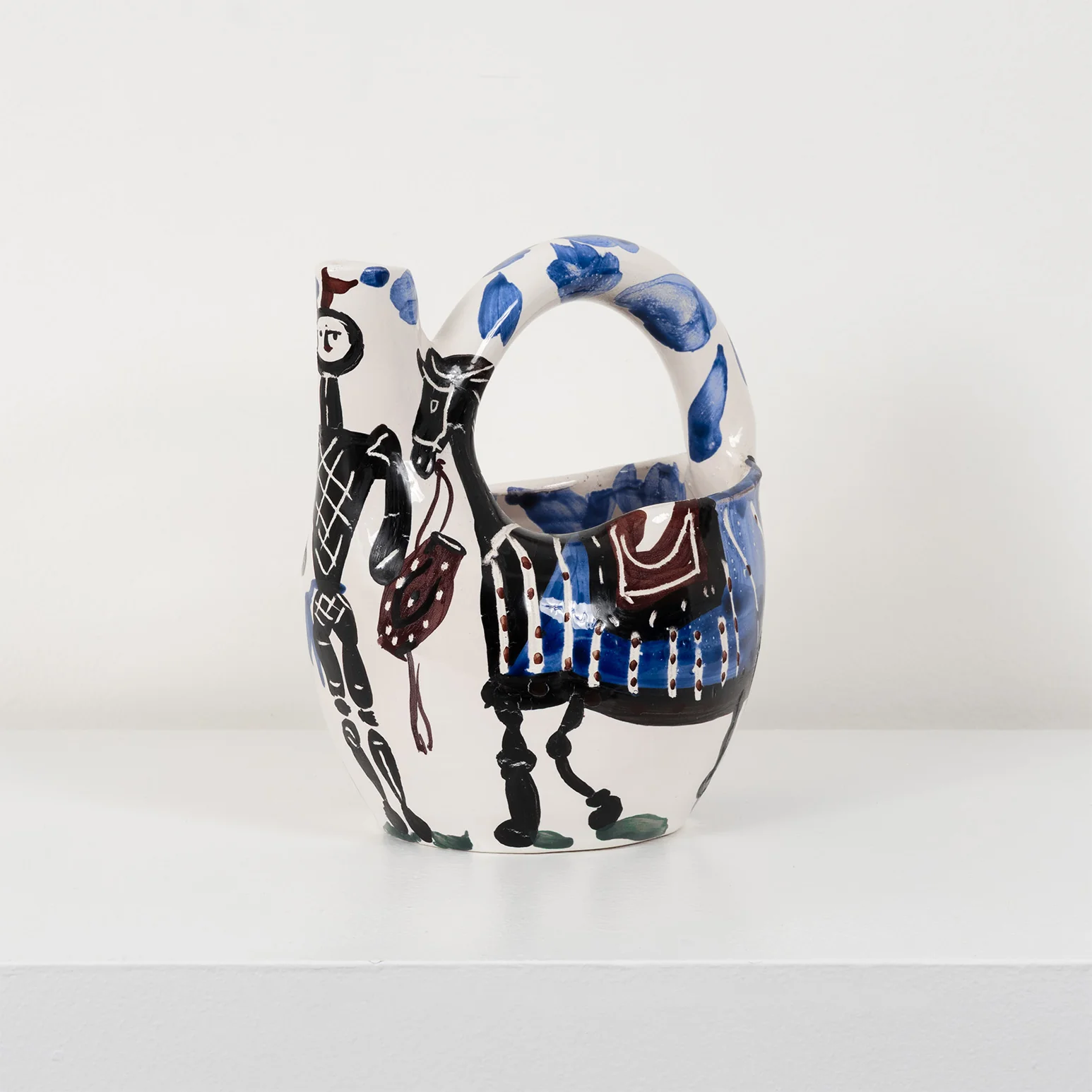
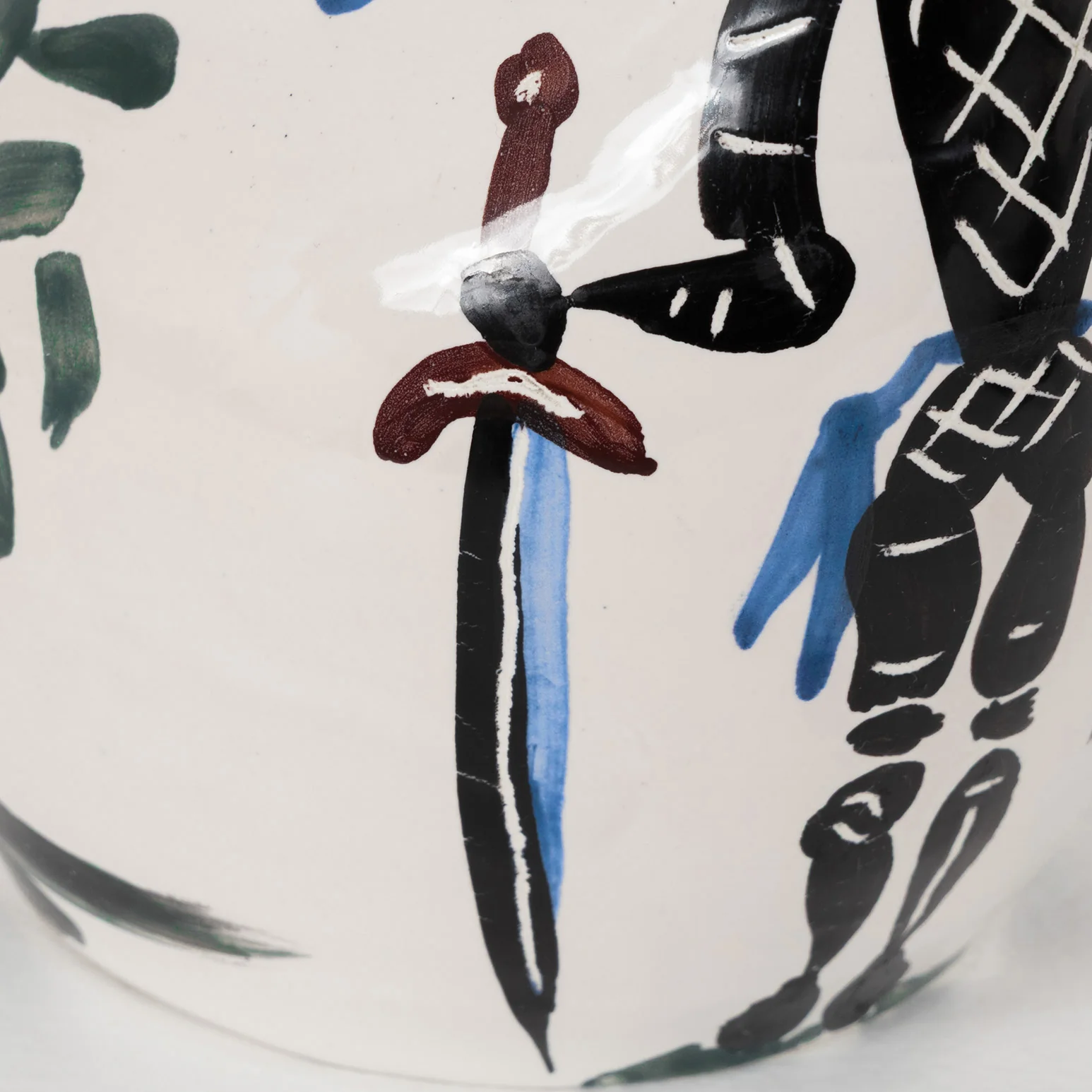
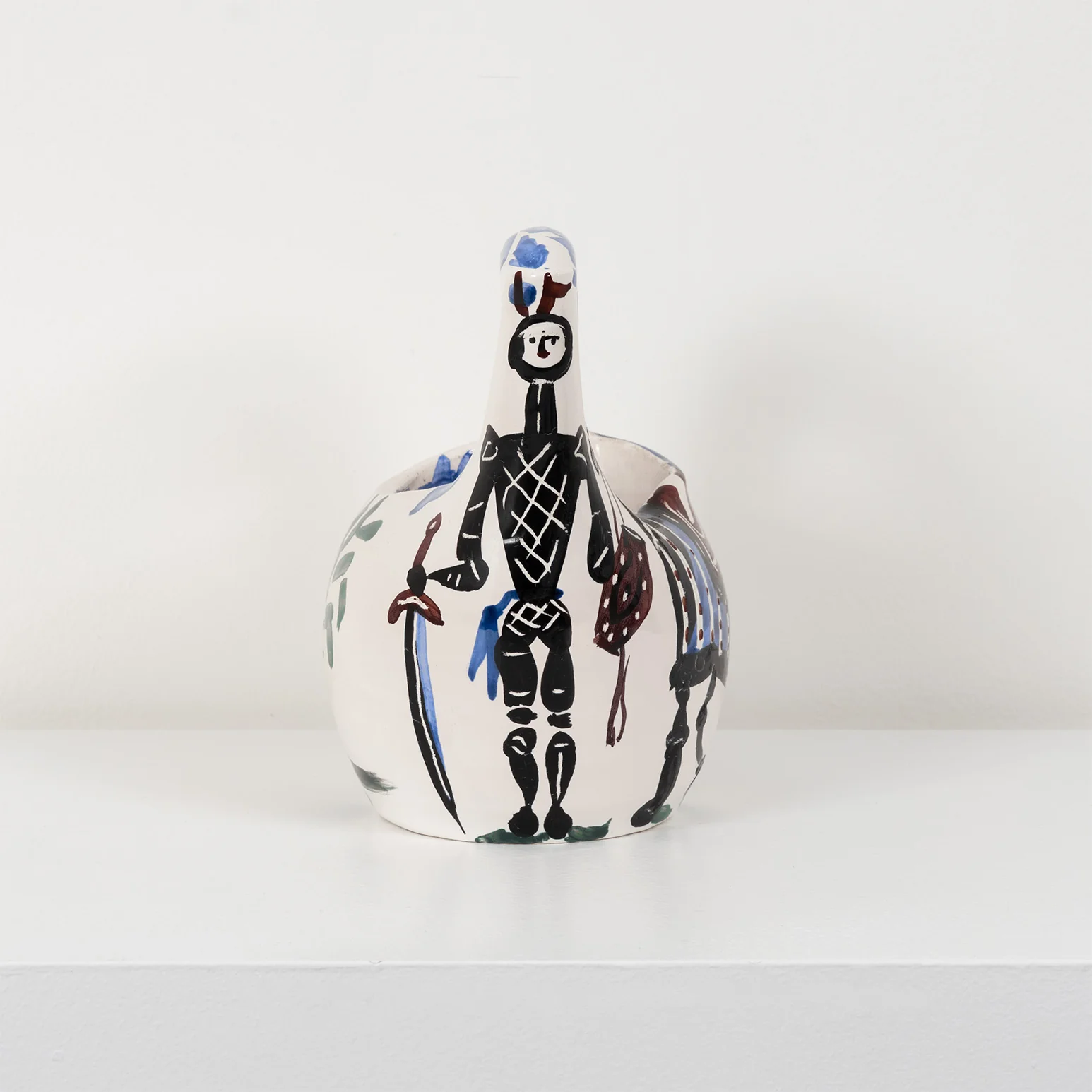
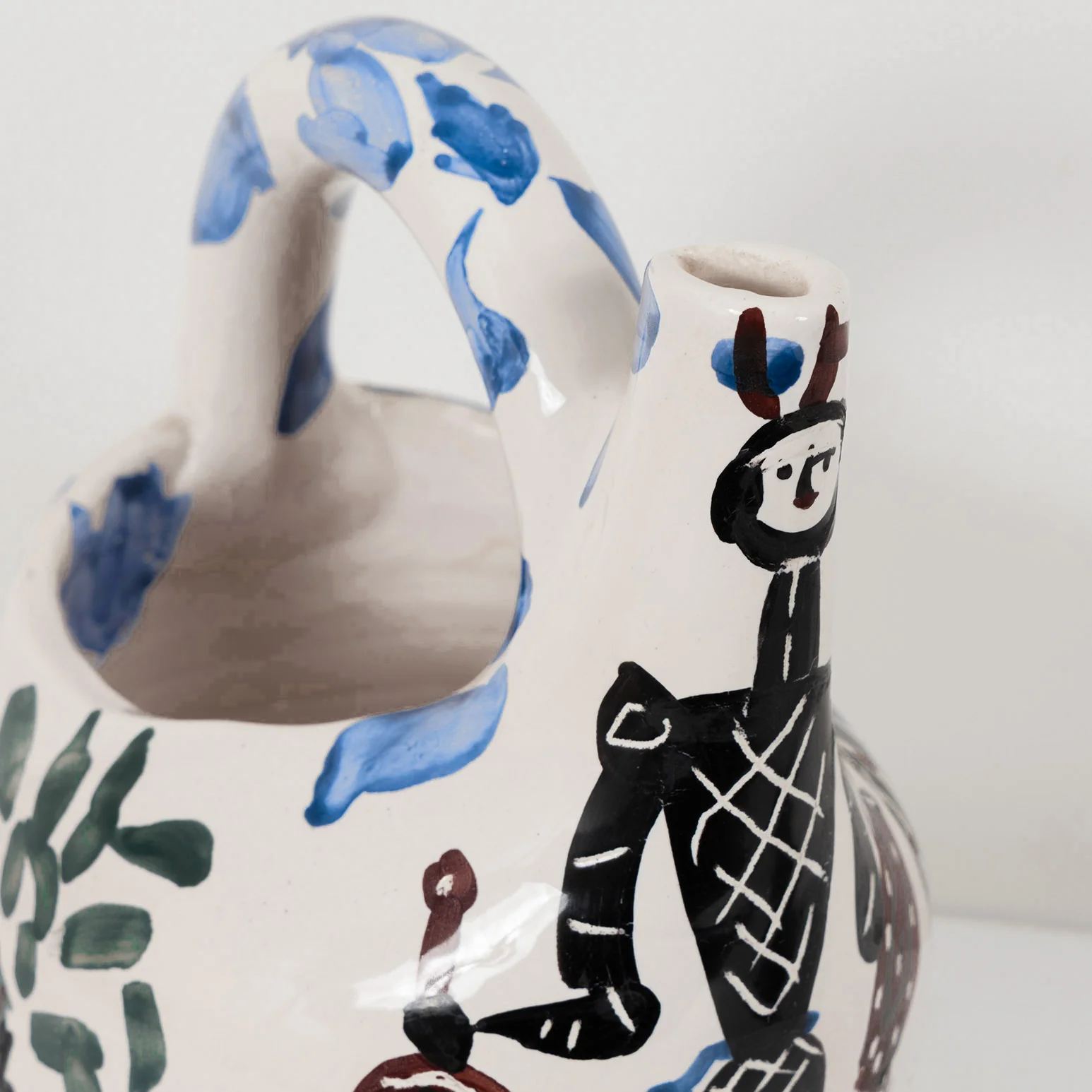
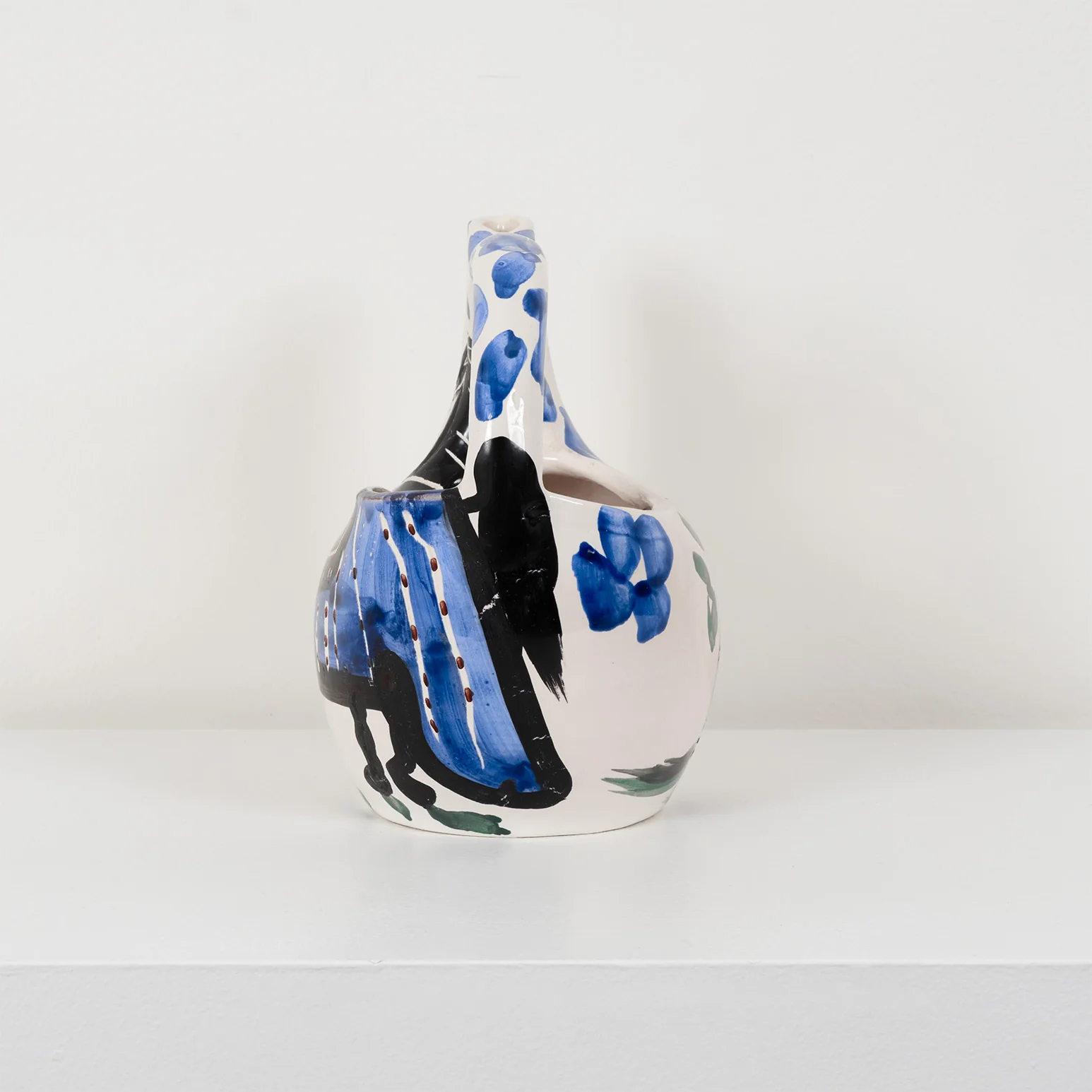
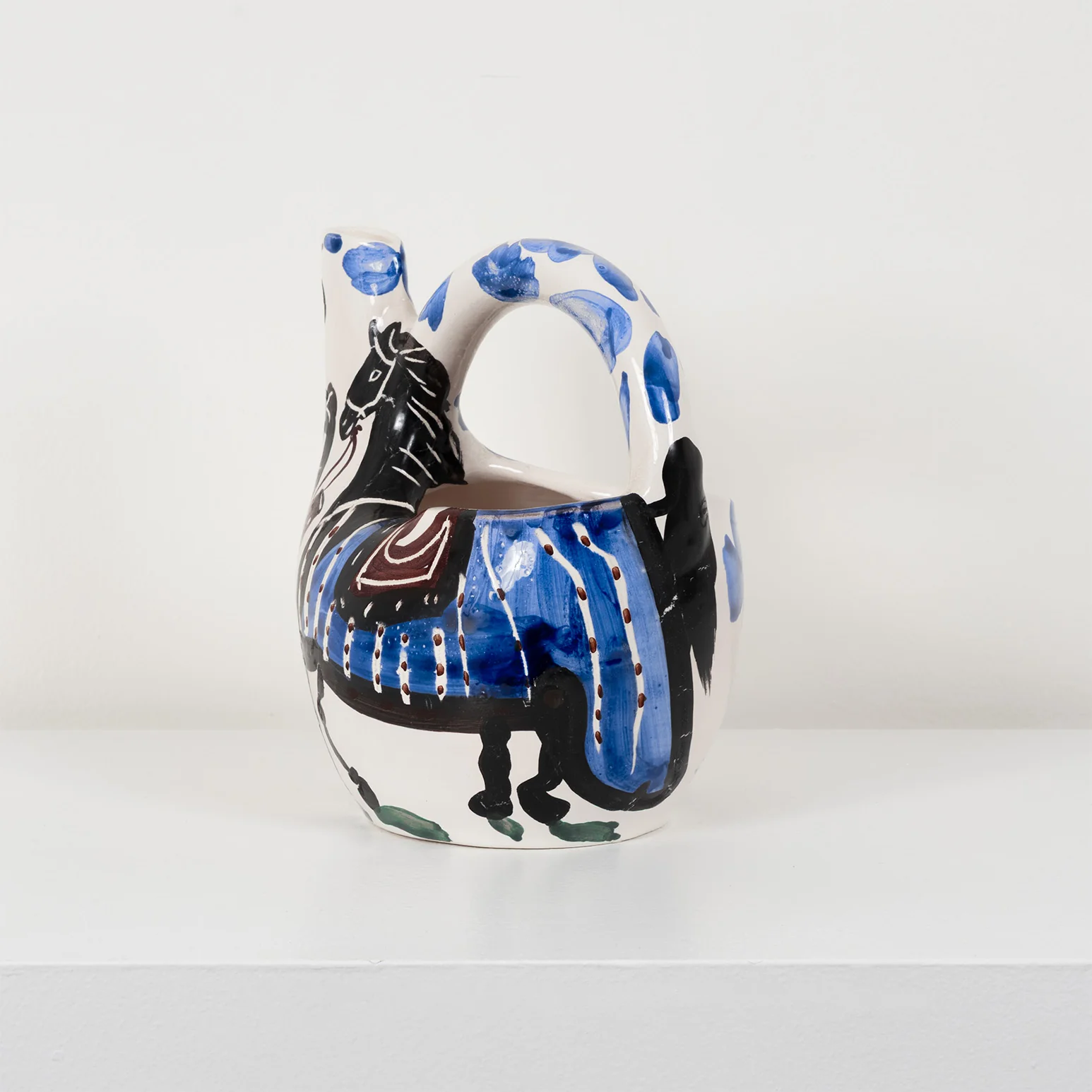
This pitcher emulates and depicts a horse and Picador, both in shape and imagery. The jug's shape is round on the sides with a tall spout on the front, it's body shaped like the horse it represents. On the front of the spout, like a figure-head on a ship, stands the Picador, leading his animal to the ring. A tree and blue petal-like shapes adorn the other side of the vessel, adding to the scene being depicted. Picasso enjoyed the Picador as an image, and depicted it throughout his oeuvre.
Picasso was known for being a prolific artist. Over a 24-year period, he is believed to have produced over 3000 unique ceramic pieces and 600 editions. Enthusiastic about the medium, he worked on plates, vases, bowls, sculptures, and pitchers.
His ceramics are imbued with a sense of joy and freedom. Having created them in his 60's and in the charming South of France at his summer home, it's no wonder Picasso was so playful with his clay creations. He ultimately met his second wife--Jacqueline Roque--at the Madoura workshop, further enhancing the uplifting motifs in this vein of his work.
Part of Picasso's drive to create pottery was that it was an accessible medium, able to be produced on a scale that his paintings could not. The ceramics were palatable to those in the general public who found his paintings to be either too expensive or too controversial. They were sold for around $100 in the 1950s and 1960s, and received little attention from important collectors. Today, however, his pottery is widely adored, with one-of-a-kind pieces showing soaring prices. In 2016, Le Hibou (Rouge et Blanc) (1953)—a unique earthenware sculpture of a patterned owl—set a record for Picasso's ceramics, fetching over $2.4 million at Christie’s.
Questions about this piece? Contact us or call +1.416.704.1720.
Visit our Toronto gallery on Thursdays or by appointment.
"Cavalier et Cheval"
France, 1952
White earthenware ceramic pitcher, partially engraved, with colored engobe and glaze
8"H 5.5"W 6"D
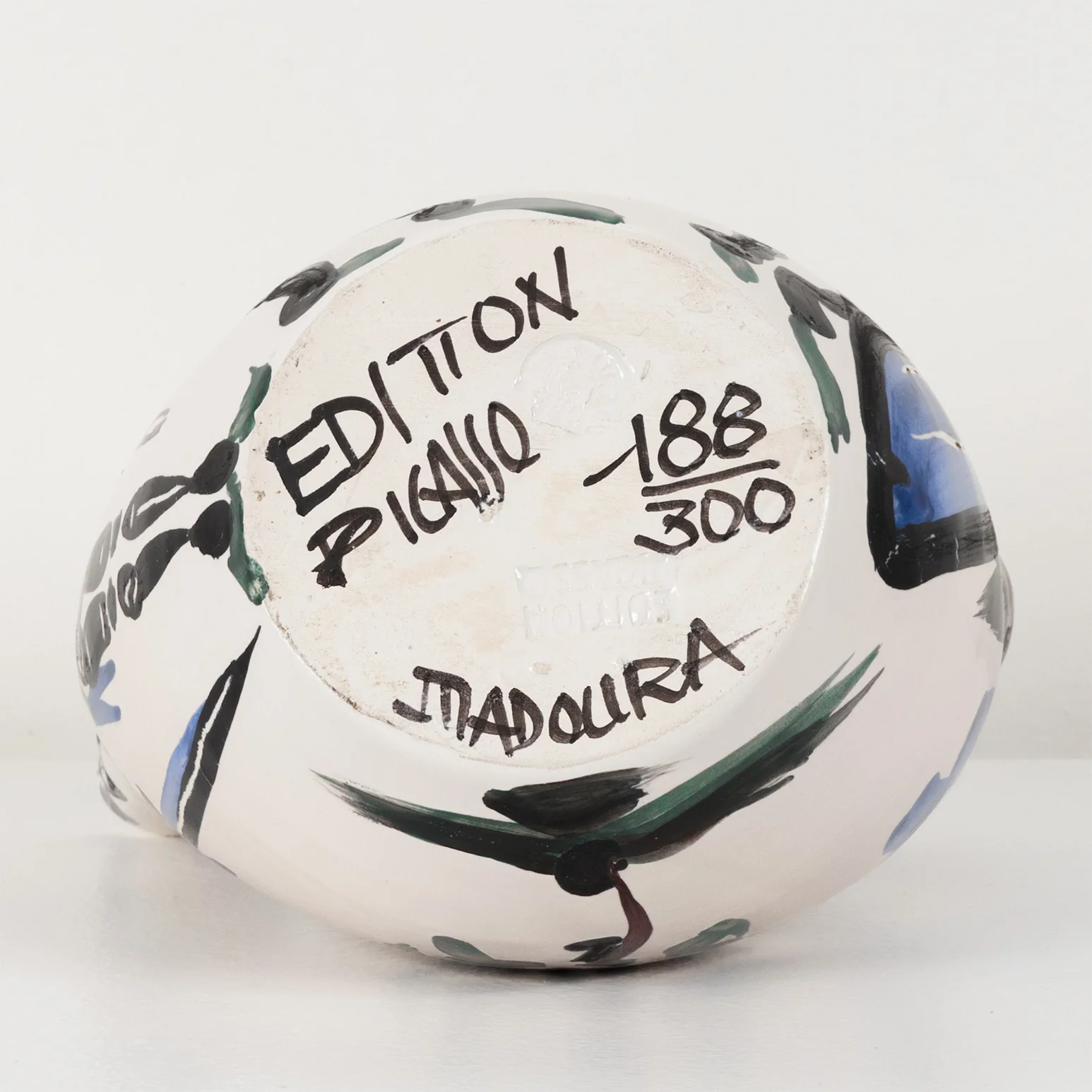
Numbered 188/300
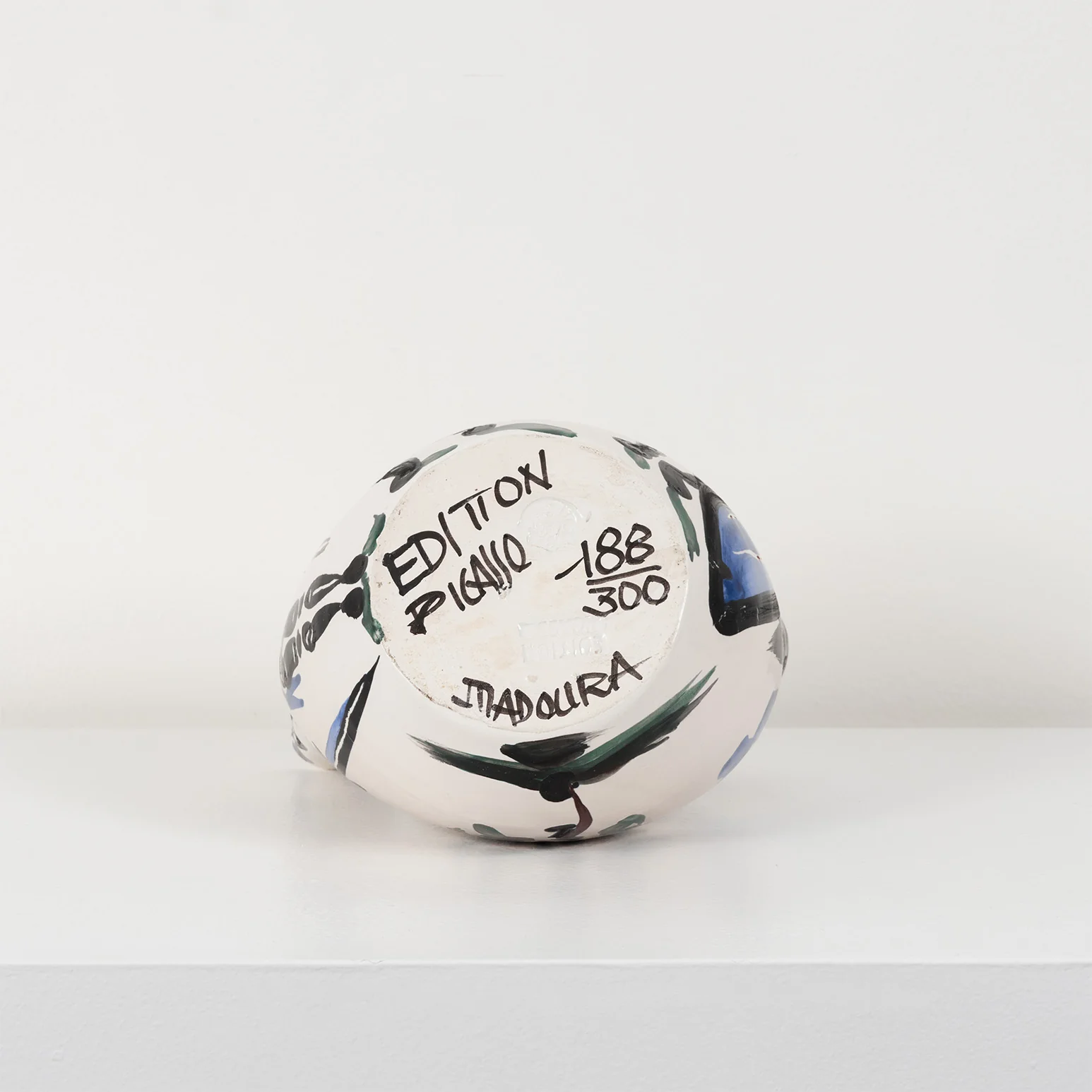
Inscribed "EDITION PICASSO" and "Madoura", glazed and painted, with the Edition Picasso and Madoura stamps on bottom
Very good condition
Literature:
Ramié, Alain: Picasso, Catalogue of the Edited Ceramic Works 1947-1971, Lyon, 1988, cat. rais. no. 137, ill.
Original: $38,500.00
-70%$38,500.00
$11,550.00More Images
PABLO PICASSO "CAVALIER ET CHEVAL" 1952
Pablo Picasso's (1881-1973) love affair with ceramics started in 1946, when he came across a pottery fair in the South of France. There, he met the proprietors of the Madoura Pottery workshop and started a collaborative relationship with the studio that lasted until his death.
Inspired by Spanish folk ceramics, Picasso embraced traditional motifs such as bullfights, roosters, suns, and faces. He appreciated the medium for combining both painting and sculpture, using the three-dimensional surfaces as a canvas for exploring his favorite motifs.
This pitcher emulates and depicts a horse and Picador, both in shape and imagery. The jug's shape is round on the sides with a tall spout on the front, it's body shaped like the horse it represents. On the front of the spout, like a figure-head on a ship, stands the Picador, leading his animal to the ring. A tree and blue petal-like shapes adorn the other side of the vessel, adding to the scene being depicted. Picasso enjoyed the Picador as an image, and depicted it throughout his oeuvre.
Picasso was known for being a prolific artist. Over a 24-year period, he is believed to have produced over 3000 unique ceramic pieces and 600 editions. Enthusiastic about the medium, he worked on plates, vases, bowls, sculptures, and pitchers.
His ceramics are imbued with a sense of joy and freedom. Having created them in his 60's and in the charming South of France at his summer home, it's no wonder Picasso was so playful with his clay creations. He ultimately met his second wife--Jacqueline Roque--at the Madoura workshop, further enhancing the uplifting motifs in this vein of his work.
Part of Picasso's drive to create pottery was that it was an accessible medium, able to be produced on a scale that his paintings could not. The ceramics were palatable to those in the general public who found his paintings to be either too expensive or too controversial. They were sold for around $100 in the 1950s and 1960s, and received little attention from important collectors. Today, however, his pottery is widely adored, with one-of-a-kind pieces showing soaring prices. In 2016, Le Hibou (Rouge et Blanc) (1953)—a unique earthenware sculpture of a patterned owl—set a record for Picasso's ceramics, fetching over $2.4 million at Christie’s.
Questions about this piece? Contact us or call +1.416.704.1720.
Visit our Toronto gallery on Thursdays or by appointment.
"Cavalier et Cheval"
France, 1952
White earthenware ceramic pitcher, partially engraved, with colored engobe and glaze
8"H 5.5"W 6"D
Numbered 188/300
Inscribed "EDITION PICASSO" and "Madoura", glazed and painted, with the Edition Picasso and Madoura stamps on bottom
Very good condition
Literature:
Ramié, Alain: Picasso, Catalogue of the Edited Ceramic Works 1947-1971, Lyon, 1988, cat. rais. no. 137, ill.
Product Information
Product Information
Shipping & Returns
Shipping & Returns
Description
Pablo Picasso's (1881-1973) love affair with ceramics started in 1946, when he came across a pottery fair in the South of France. There, he met the proprietors of the Madoura Pottery workshop and started a collaborative relationship with the studio that lasted until his death.
Inspired by Spanish folk ceramics, Picasso embraced traditional motifs such as bullfights, roosters, suns, and faces. He appreciated the medium for combining both painting and sculpture, using the three-dimensional surfaces as a canvas for exploring his favorite motifs.
This pitcher emulates and depicts a horse and Picador, both in shape and imagery. The jug's shape is round on the sides with a tall spout on the front, it's body shaped like the horse it represents. On the front of the spout, like a figure-head on a ship, stands the Picador, leading his animal to the ring. A tree and blue petal-like shapes adorn the other side of the vessel, adding to the scene being depicted. Picasso enjoyed the Picador as an image, and depicted it throughout his oeuvre.
Picasso was known for being a prolific artist. Over a 24-year period, he is believed to have produced over 3000 unique ceramic pieces and 600 editions. Enthusiastic about the medium, he worked on plates, vases, bowls, sculptures, and pitchers.
His ceramics are imbued with a sense of joy and freedom. Having created them in his 60's and in the charming South of France at his summer home, it's no wonder Picasso was so playful with his clay creations. He ultimately met his second wife--Jacqueline Roque--at the Madoura workshop, further enhancing the uplifting motifs in this vein of his work.
Part of Picasso's drive to create pottery was that it was an accessible medium, able to be produced on a scale that his paintings could not. The ceramics were palatable to those in the general public who found his paintings to be either too expensive or too controversial. They were sold for around $100 in the 1950s and 1960s, and received little attention from important collectors. Today, however, his pottery is widely adored, with one-of-a-kind pieces showing soaring prices. In 2016, Le Hibou (Rouge et Blanc) (1953)—a unique earthenware sculpture of a patterned owl—set a record for Picasso's ceramics, fetching over $2.4 million at Christie’s.
Questions about this piece? Contact us or call +1.416.704.1720.
Visit our Toronto gallery on Thursdays or by appointment.
"Cavalier et Cheval"
France, 1952
White earthenware ceramic pitcher, partially engraved, with colored engobe and glaze
8"H 5.5"W 6"D
Numbered 188/300
Inscribed "EDITION PICASSO" and "Madoura", glazed and painted, with the Edition Picasso and Madoura stamps on bottom
Very good condition
Literature:
Ramié, Alain: Picasso, Catalogue of the Edited Ceramic Works 1947-1971, Lyon, 1988, cat. rais. no. 137, ill.