PABLO PICASSO "SCENE DE TAUROMACHIE" 1959
Pablo Picasso's (1881-1973) love affair with ceramics started in 1946, when he came across a pottery fair in the South of France. There, he met the proprietors of the Madoura Pottery workshop and started a collaborative relationship with the studio that lasted until his death.
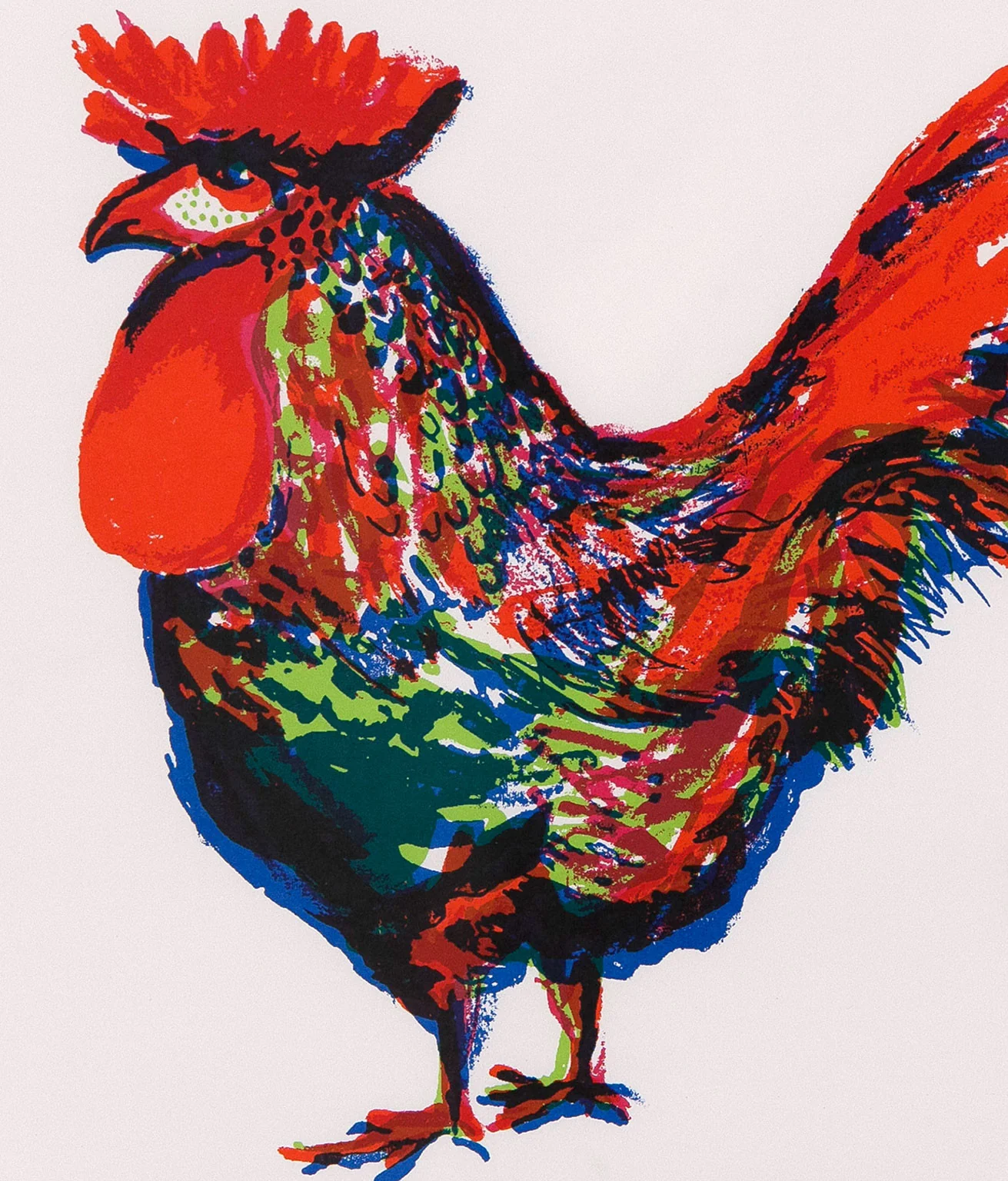
Inspired by Spanish folk ceramics, Picasso embraced traditional motifs such as bullfights, roosters, suns, and faces. He appreciated the medium for combining both painting and sculpture, using the three-dimensional surfaces as a canvas for exploring his favorite motifs.
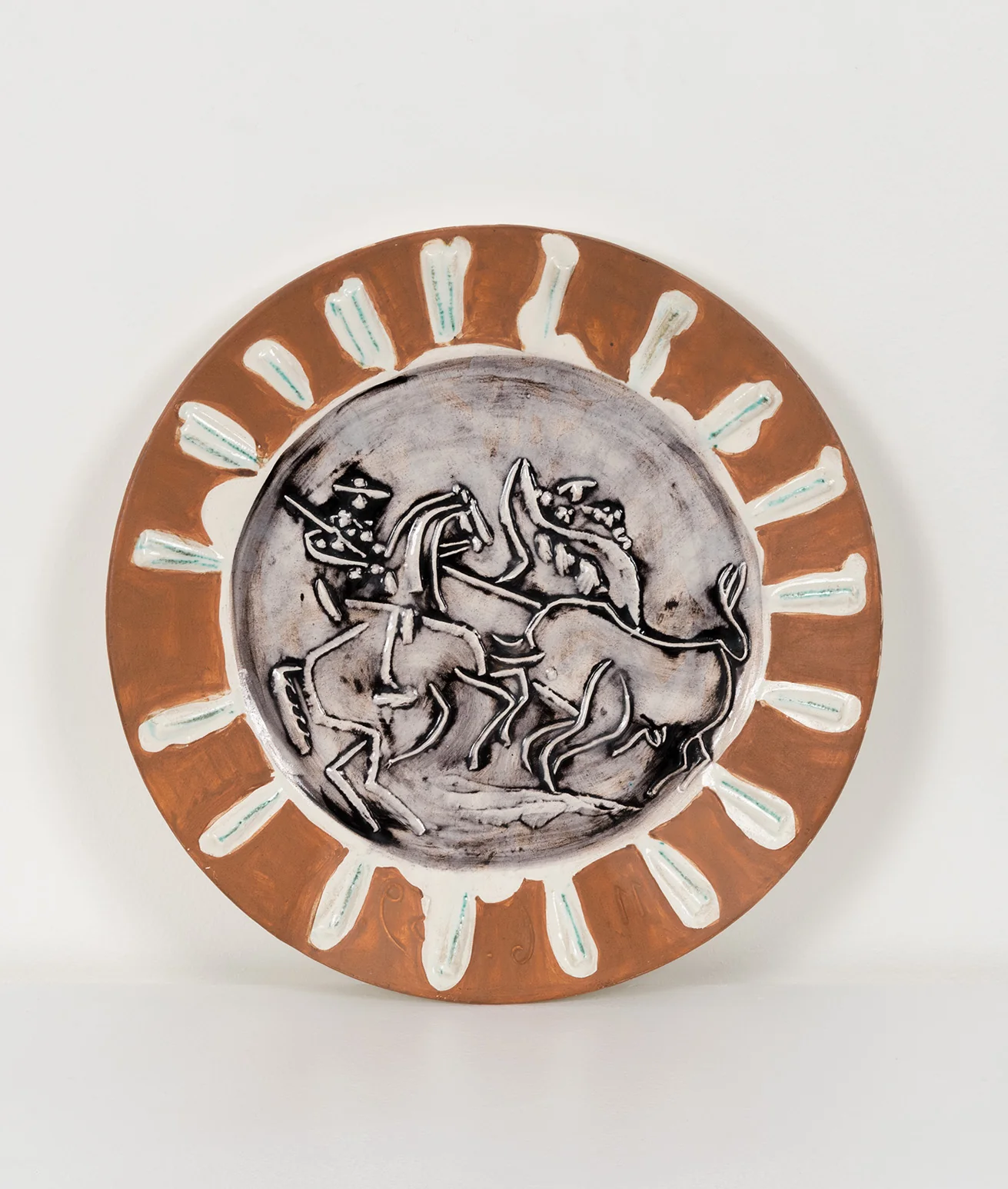
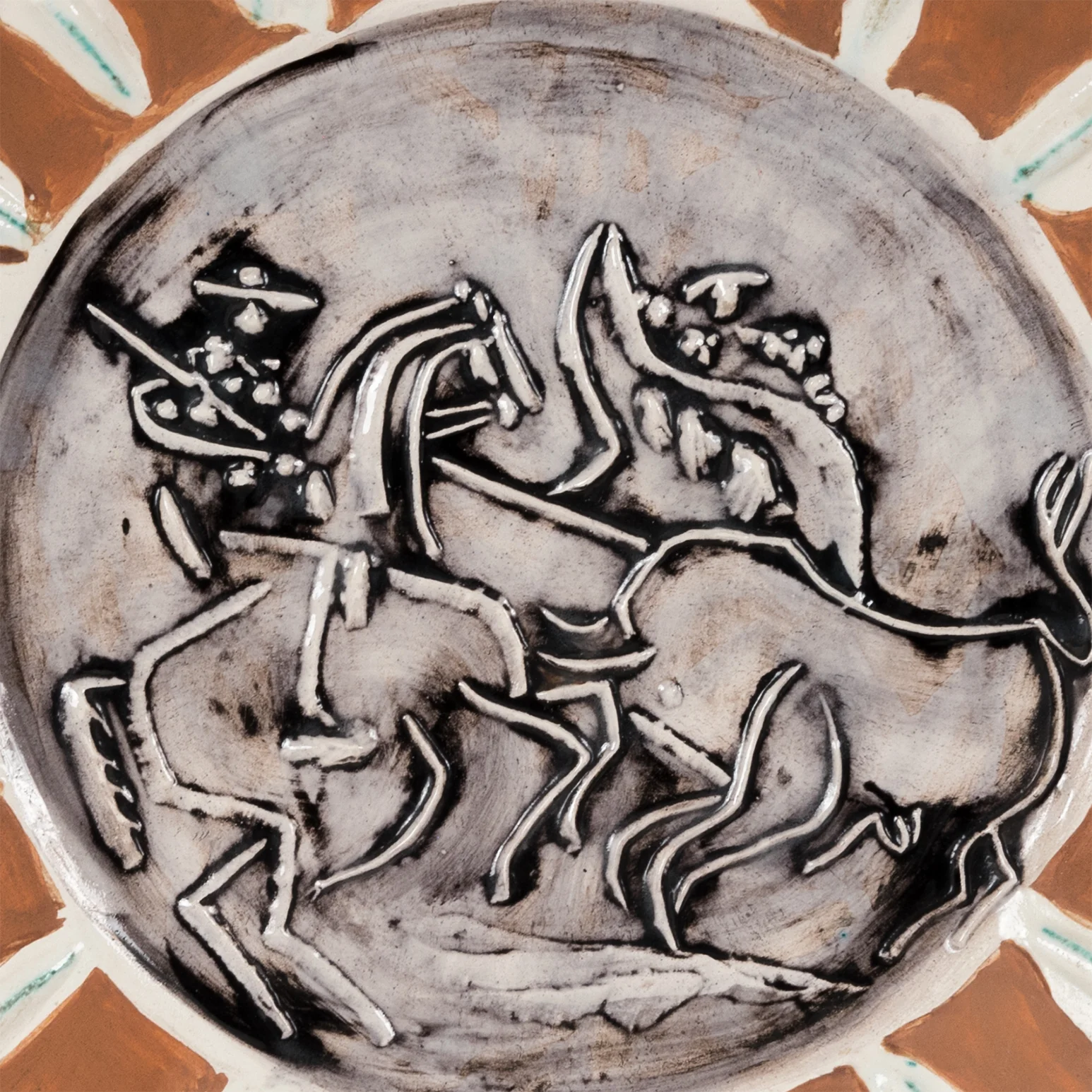
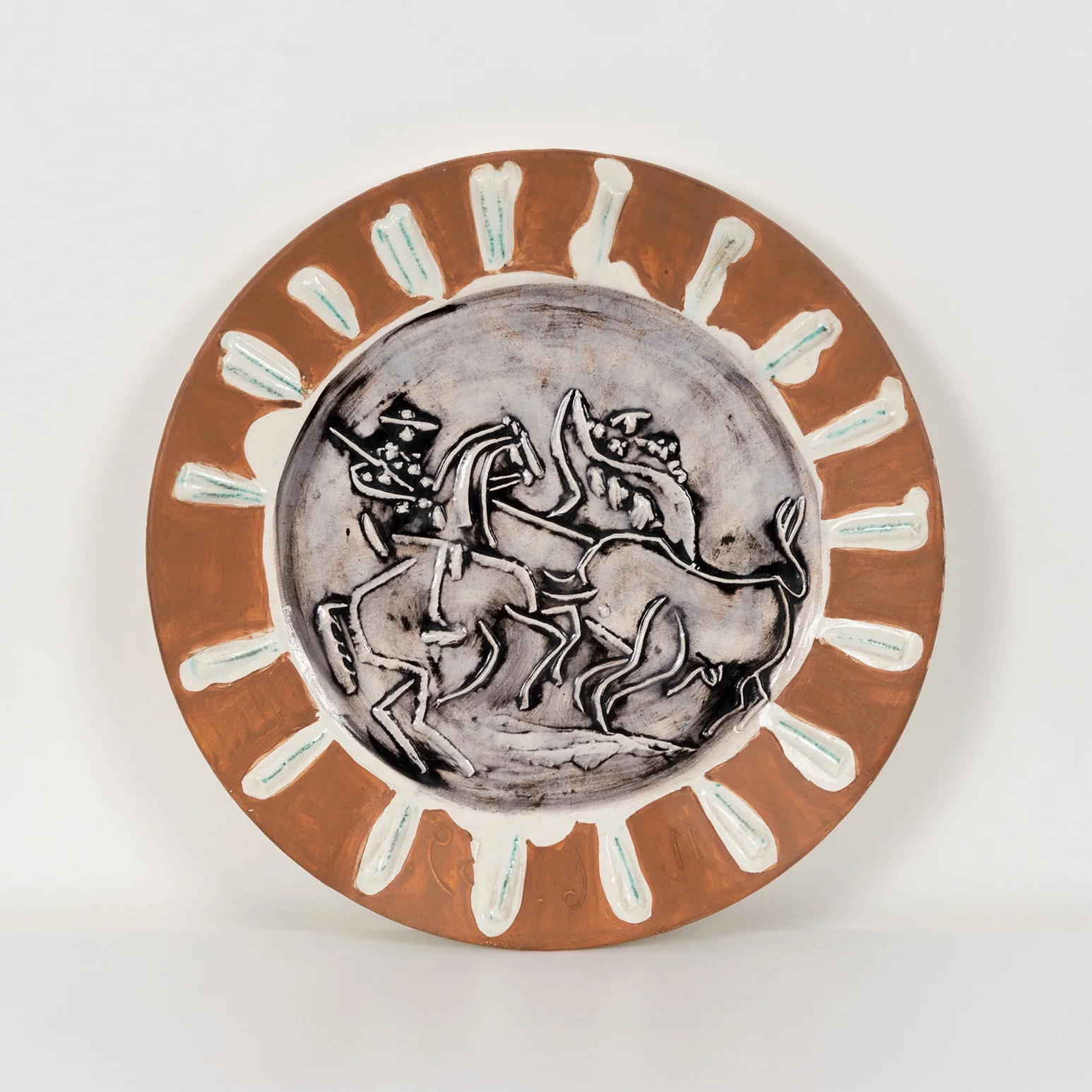
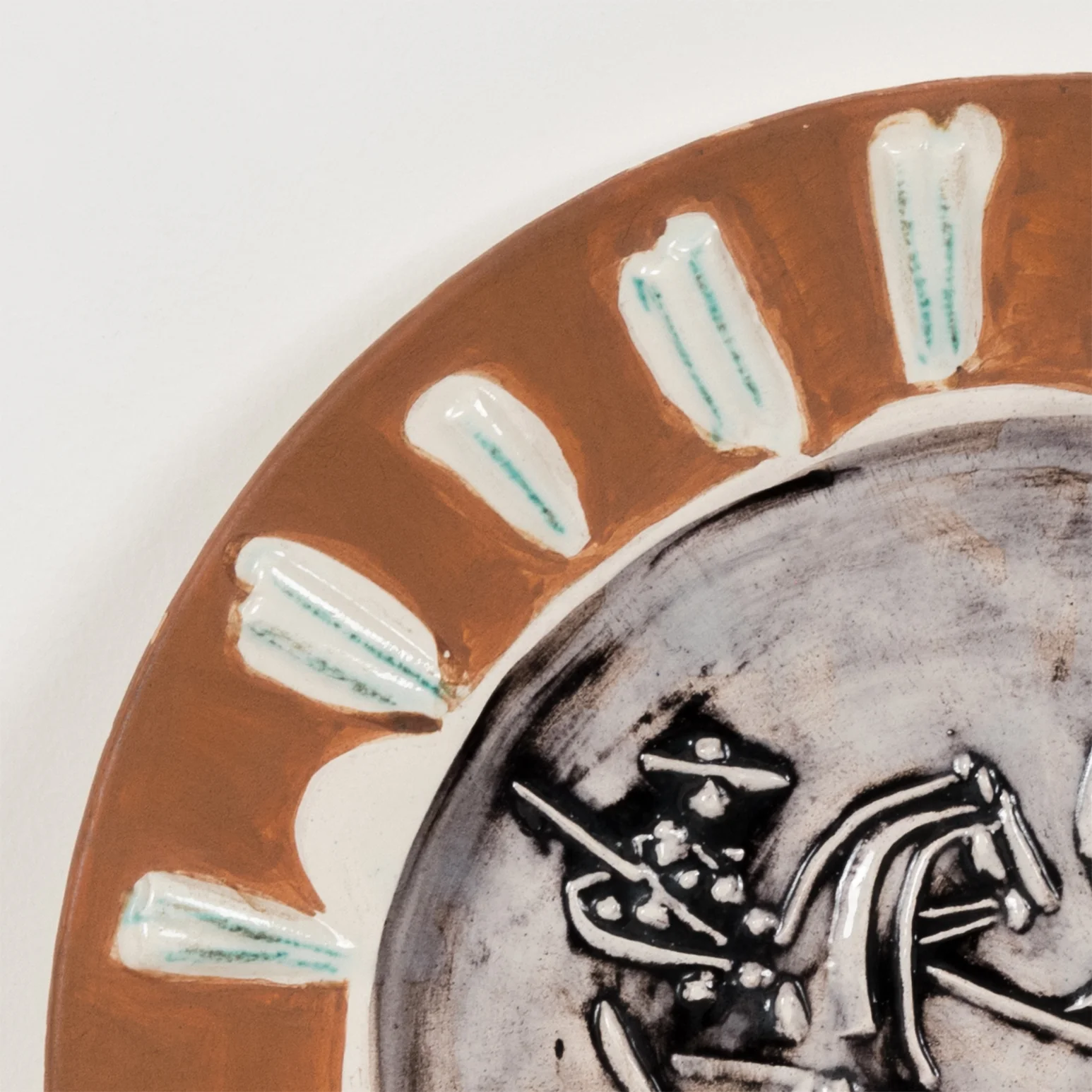
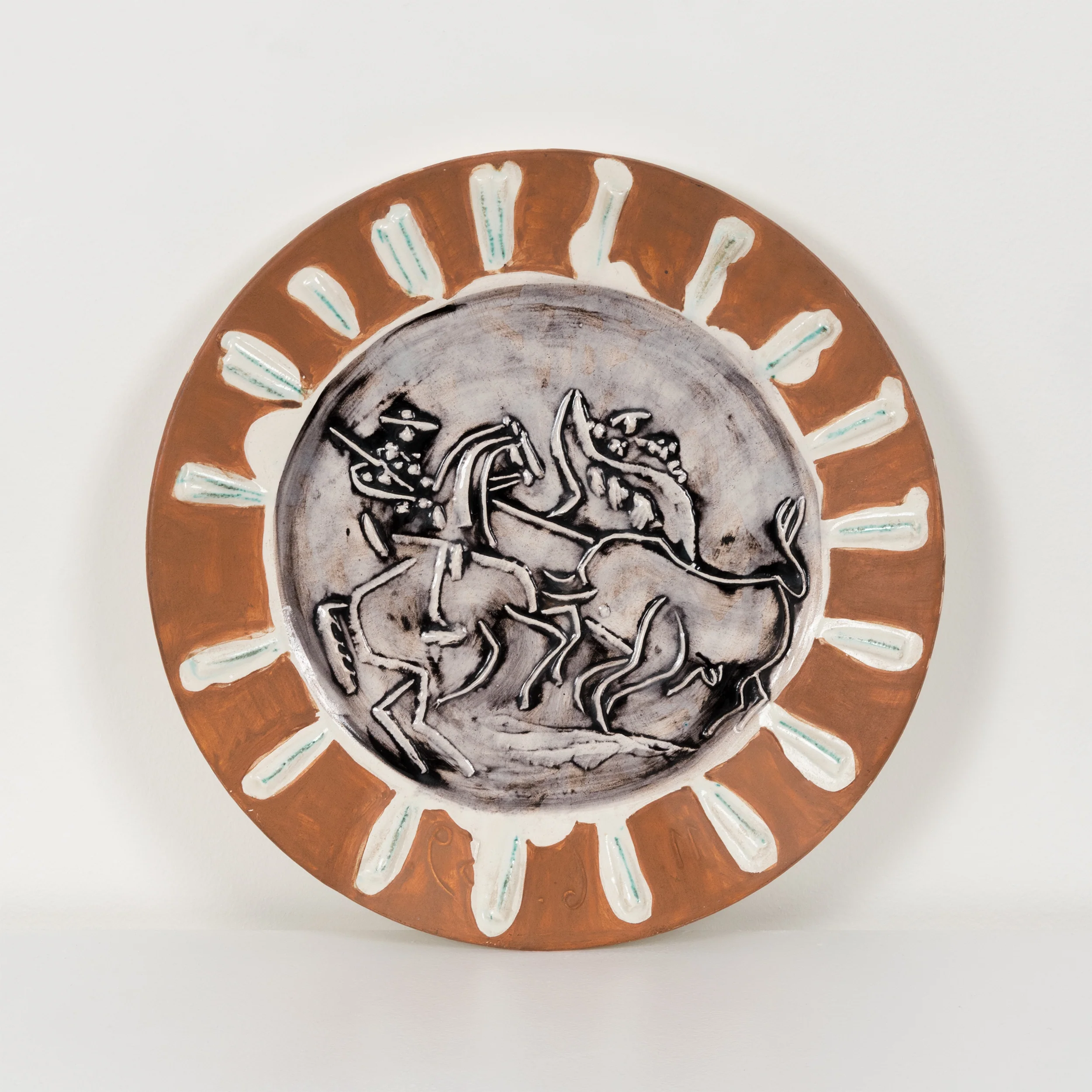
This charger depicts a bullfight in it's pivotal moment. Shrouded in a haze of smoky grey, the two matadors are locked in battle with their wild opponent. The matadors' dynamic bravery on full display. The charger's shape naturally emulates a bullfighting ring. The decorative lines around the rim highlights the scene, and mimics the gaze of spectators. Textured, representational and energetic, this plate is a wonderful representation of Picasso's ceramic output.
Picasso was an avid patron of bullfights, attending from an early age as a child in Spain. These bullfighting scenes (or Scenes de Tauromachie) appear very early in his work, providing consistent influence throughout his oeuvre. It was also a common scene in many of his Madoura ceramics.
Part of Picasso's dedication to pottery was because of its accessibility, and its seriality. His ceramics were sold for around $100 in the 1950s and 1960s. Today, however, his pottery is widely adored and collected. In 2016, Le Hibou (Rouge et Blanc) (1953)—a unique earthenware sculpture of a patterned owl—set a record for Picasso's ceramics, fetching over $2.4 million at Christie’s.
Questions about this piece? Contact us or call +1.416.704.1720.
Visit our Toronto gallery on Thursdays or by appointment.
"Scène de Tauromachie"
France, 1959
Madoura round dish of white earthenware clay with decoration in englobes (ivory, painted black, mat russet) under partial brushed glaze
Diameter: 16.5"
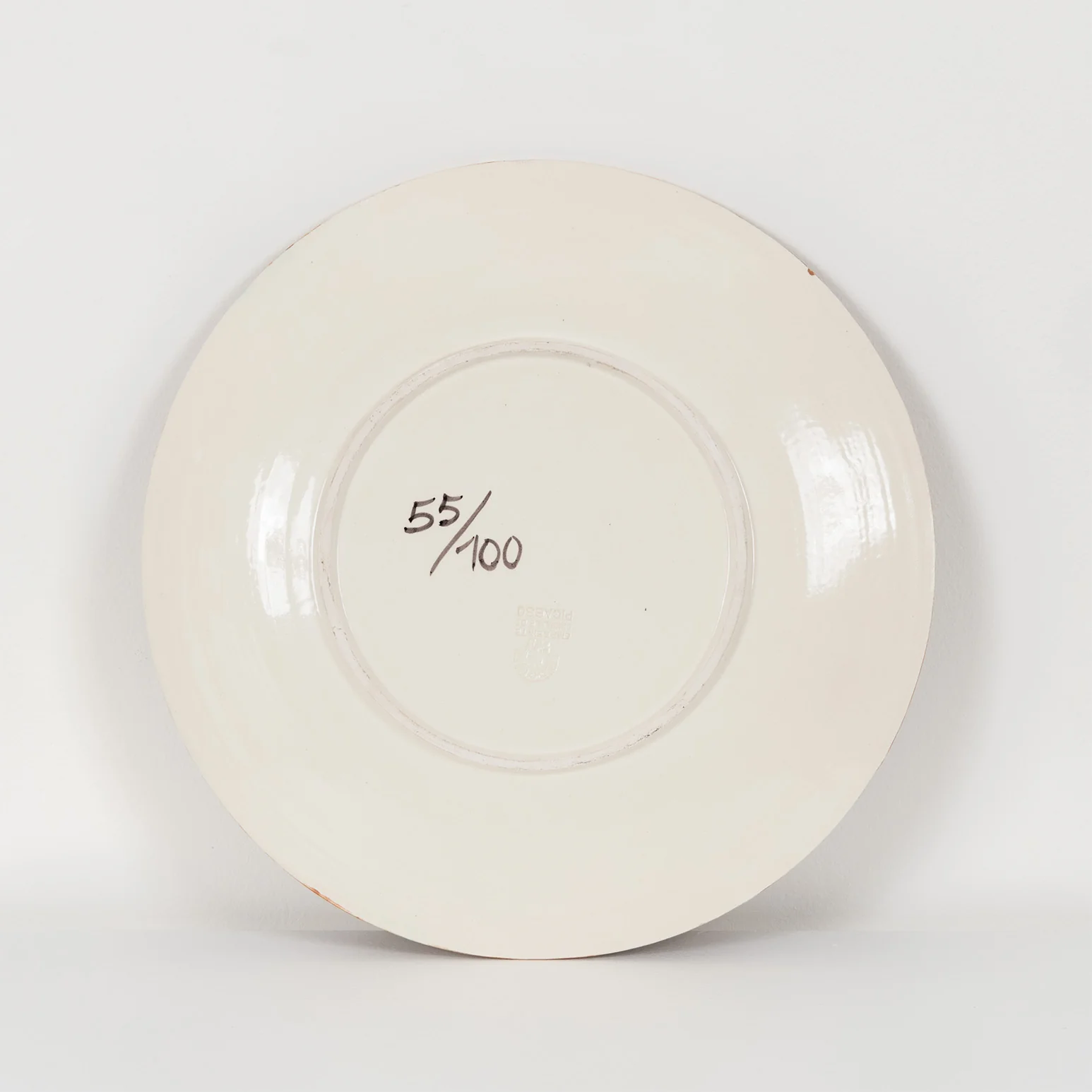
Numbered 55/100
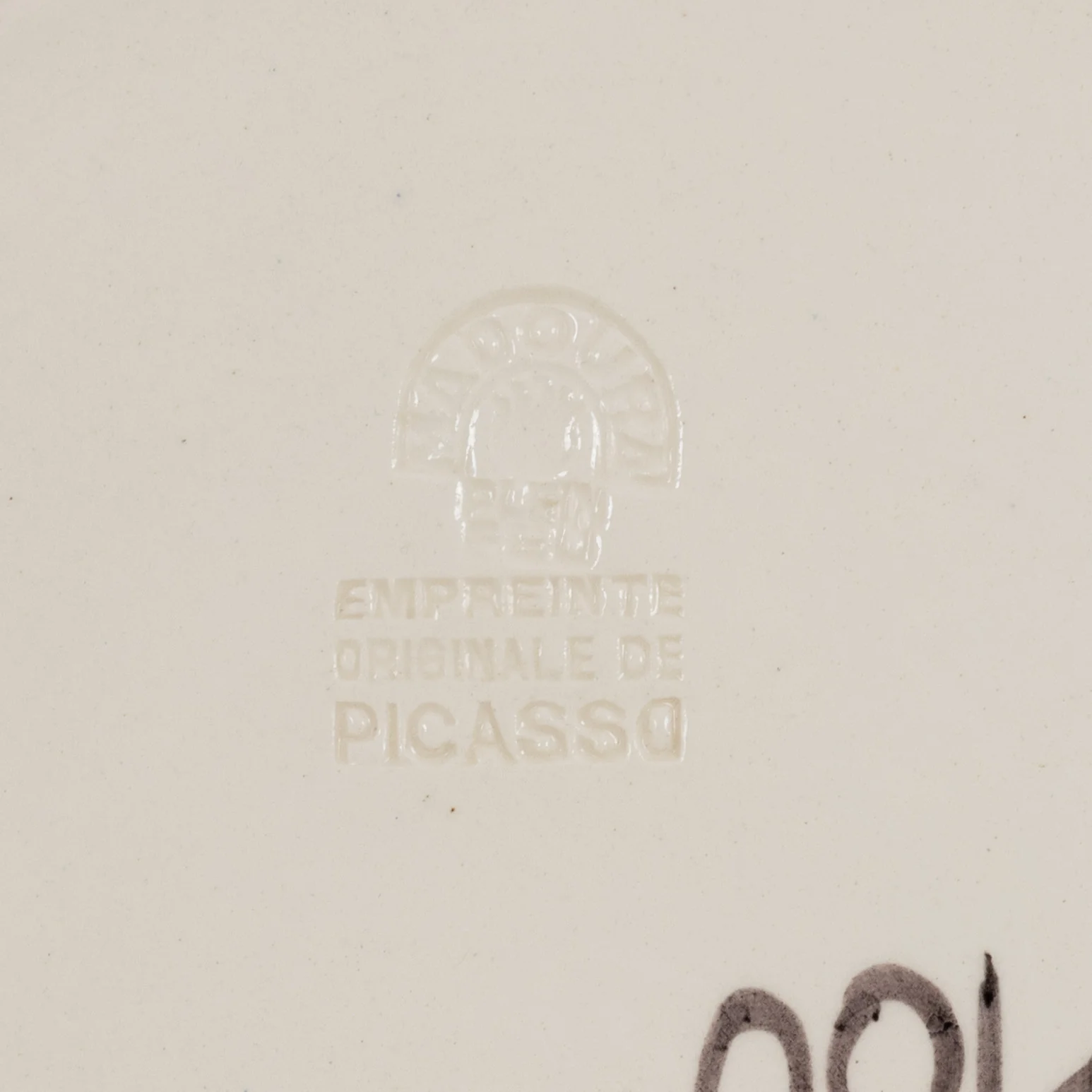
Impressions of the Madoura stamp "MADOURA PLEIN FEU" and Picasso stamp "EMRPEINTE ORIGINALE DE PICASSO" on verso
Produced by Madoura Pottery, Vallauris, France
Very good condition
Literature: Ramié, Alain. Picasso Catalogue of the edited ceramic works 1947-1971. Madoura: 1988. Listed and illustrated as catalogue raisonné work no. 410.
More Images
PABLO PICASSO "SCENE DE TAUROMACHIE" 1959
Pablo Picasso's (1881-1973) love affair with ceramics started in 1946, when he came across a pottery fair in the South of France. There, he met the proprietors of the Madoura Pottery workshop and started a collaborative relationship with the studio that lasted until his death.
Inspired by Spanish folk ceramics, Picasso embraced traditional motifs such as bullfights, roosters, suns, and faces. He appreciated the medium for combining both painting and sculpture, using the three-dimensional surfaces as a canvas for exploring his favorite motifs.
This charger depicts a bullfight in it's pivotal moment. Shrouded in a haze of smoky grey, the two matadors are locked in battle with their wild opponent. The matadors' dynamic bravery on full display. The charger's shape naturally emulates a bullfighting ring. The decorative lines around the rim highlights the scene, and mimics the gaze of spectators. Textured, representational and energetic, this plate is a wonderful representation of Picasso's ceramic output.
Picasso was an avid patron of bullfights, attending from an early age as a child in Spain. These bullfighting scenes (or Scenes de Tauromachie) appear very early in his work, providing consistent influence throughout his oeuvre. It was also a common scene in many of his Madoura ceramics.
Part of Picasso's dedication to pottery was because of its accessibility, and its seriality. His ceramics were sold for around $100 in the 1950s and 1960s. Today, however, his pottery is widely adored and collected. In 2016, Le Hibou (Rouge et Blanc) (1953)—a unique earthenware sculpture of a patterned owl—set a record for Picasso's ceramics, fetching over $2.4 million at Christie’s.
Questions about this piece? Contact us or call +1.416.704.1720.
Visit our Toronto gallery on Thursdays or by appointment.
"Scène de Tauromachie"
France, 1959
Madoura round dish of white earthenware clay with decoration in englobes (ivory, painted black, mat russet) under partial brushed glaze
Diameter: 16.5"
Numbered 55/100
Impressions of the Madoura stamp "MADOURA PLEIN FEU" and Picasso stamp "EMRPEINTE ORIGINALE DE PICASSO" on verso
Produced by Madoura Pottery, Vallauris, France
Very good condition
Literature: Ramié, Alain. Picasso Catalogue of the edited ceramic works 1947-1971. Madoura: 1988. Listed and illustrated as catalogue raisonné work no. 410.
Product Information
Product Information
Shipping & Returns
Shipping & Returns
Description
Pablo Picasso's (1881-1973) love affair with ceramics started in 1946, when he came across a pottery fair in the South of France. There, he met the proprietors of the Madoura Pottery workshop and started a collaborative relationship with the studio that lasted until his death.
Inspired by Spanish folk ceramics, Picasso embraced traditional motifs such as bullfights, roosters, suns, and faces. He appreciated the medium for combining both painting and sculpture, using the three-dimensional surfaces as a canvas for exploring his favorite motifs.
This charger depicts a bullfight in it's pivotal moment. Shrouded in a haze of smoky grey, the two matadors are locked in battle with their wild opponent. The matadors' dynamic bravery on full display. The charger's shape naturally emulates a bullfighting ring. The decorative lines around the rim highlights the scene, and mimics the gaze of spectators. Textured, representational and energetic, this plate is a wonderful representation of Picasso's ceramic output.
Picasso was an avid patron of bullfights, attending from an early age as a child in Spain. These bullfighting scenes (or Scenes de Tauromachie) appear very early in his work, providing consistent influence throughout his oeuvre. It was also a common scene in many of his Madoura ceramics.
Part of Picasso's dedication to pottery was because of its accessibility, and its seriality. His ceramics were sold for around $100 in the 1950s and 1960s. Today, however, his pottery is widely adored and collected. In 2016, Le Hibou (Rouge et Blanc) (1953)—a unique earthenware sculpture of a patterned owl—set a record for Picasso's ceramics, fetching over $2.4 million at Christie’s.
Questions about this piece? Contact us or call +1.416.704.1720.
Visit our Toronto gallery on Thursdays or by appointment.
"Scène de Tauromachie"
France, 1959
Madoura round dish of white earthenware clay with decoration in englobes (ivory, painted black, mat russet) under partial brushed glaze
Diameter: 16.5"
Numbered 55/100
Impressions of the Madoura stamp "MADOURA PLEIN FEU" and Picasso stamp "EMRPEINTE ORIGINALE DE PICASSO" on verso
Produced by Madoura Pottery, Vallauris, France
Very good condition
Literature: Ramié, Alain. Picasso Catalogue of the edited ceramic works 1947-1971. Madoura: 1988. Listed and illustrated as catalogue raisonné work no. 410.